

Invenergy, the Chicago-based fossil fuel energy company that wants to build a $1 billion fracked gas and diesel oil burning power plant in the heart of the pristine forests of northwest Rhode Island, is going to make a handsome profit in the New England energy market - $20 million - and it doesn't have to produce a single kilowatt of energy to do so. How Invenergy managed this feat is complicated, but thankfully Jerry Elmer, Senior Attorney at Conservation Law Foundation (CLF) explained it all to me. The following information is based entirely on Elmer's explanation.
Back in February 2016, Invenergy entered an energy auction, Forward Capacity Auction 10 (FCA-10), with the expectation that they would be in full production on at least one of their two proposed turbines at their yet-to-be built Rhode Island power plant. Energy prices in New England are set three years in advance. What we pay today is based on decisions made three years ago by speculators like Invenergy and every other power plant company, whether that power comes from fossil fuels or renewables.
Invenergy won a Capacity Supply Obligation (CSO) of 485 MW (on Turbine One only) that it acquired in FCA-10, meaning that they promised to produce up to 485 megawatts of electricity for New England from June 1, 2020 through May 31, 2021.
Of course, Invenergy can't meet this obligation, as they have no power plant in New England, so Invenergy sold their obligation to another company.
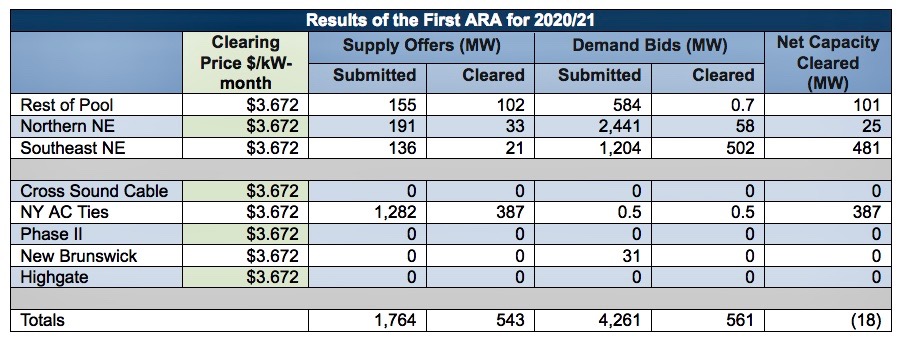
On Tuesday, January 19, ISO New England, the not-for-profit corporation responsible for overseeing the region’s bulk power grid, wholesale electricity markets, and power system planning, published the results of its first Annual Reconfiguration Auction (ARA-1) for Capacity Commitment Period-11 (CCP-11).
This isn't really news: Invenergy had to sell it's electricity production obligations. But according to Jerry Elmer:
"The reason that this is important is that the FERC-approved ISO Tariff allows the ISO to involuntarily terminate the CSO of a generator that is non-commercial for two consecutive years. That is now the situation that Invenergy is in. Invenergy promised the ISO that it would be in commercial operation on June 1, 2019. But:
Uprise RI is entirely supported by donations and advertising. Every little bit helps: Become a Patron!
"Thus, one year ago, in an ISO-run Annual Reconfiguration Auction, Invenergy was forced, against its will, to sell out of its CSO for the period June 1, 2019 to May 31, 2020. This year, an another ISO-run ARA, Invenergy was forced, against its will, to sell out of its CSO for the period June 1, 2020 to May 31, 2021. As a result, Invenergy is now in the unfortunate position of being a non-commercial resource for two consecutive Capacity Commitment Periods. This triggers the ISO Tariff provision that allows the ISO to involuntarily discontinue Invenergy’s 485 MW CSO permanently." Elmer notes that, "The ISO Tariff provision I am referring to is permissive, not mandatory. In other words, this provision allows the ISO to terminate Invenergy’s CSO permanently; it does not require the ISO to do so. We will see over the next few months whether (or not) the ISO elects to terminate Invenergy’s CSO." Elmer additionally notes that, "Remember that Invenergy’s 485 MW CSO is for Turbine One. Turbine Two failed to clear the auction in FCA-10; Turbine Two failed to clear again in FCA-11 (February 2017); Turbine Two was disqualified from even participating in FCA-12 (February 2018).)" So, will the ISO terminate Invenergy’s CSO? "No one knows." writes Elmer. "That is up to the ISO. However, CLF believes that the ISO should terminate Invenergy’s CSO for multiple reasons. First, the plant is not needed. Second, the plant is costing ratepayers millions of dollars, even though it may very well never be built. Third, the plant would burn only fossil fuels: diesel oil and natural gas, both of which emit carbon pollution that cause climate change. "The ISO needs to evaluate all of these factors, plus more," continued Elmer. "Since Invenergy may ultimately never be built, those 485 megawatts from Turbine One go into all future Forward Capacity Auctions as so-called 'existing resources,' – even though they may very well be phantom resources, that is, never be built. (That is, the 485 MW that cleared in FCA-10, in February 2016, went into FCA-11 and FCA-12 as 'existing resources.' Those megawatts will continue to go into future auctions as “existing resources,” until and unless the ISO terminates Invenergy’s CSO.) The presence of phantom resources in the auction affects the clearing price of every auction. Under the Federal Power Act, the ISO is legally obligated to ensure that electricity rates are 'just and reasonable.' But, by definition, the clearing prices of every auction are being distorted by the presence of these “phantom megawatts.” Elmer continues:
- Invenergy has no Energy Facilities Siting Board (EFSB) permit;
- Invenergy has no Rhode Island Department of Environmental Management Major Source Air Permit;
- Invenergy has no Interconnection Agreement with National Grid;
- Invenergy has not yet broken ground on its proposed plant.
"There is one additional matter that will be of keen interest to the public and to ratepayers: the money that Invenergy makes on all of this. Back in February 2016, when Invenergy cleared one turbine in FCA-10, the auction clearing price paid to Invenergy (and every other new resource that cleared in that auction) was $7.03/kW-mo., a relatively high amount. Under the ISO Tariff, Invenergy was allowed to, and did, lock in that price for seven consecutive years. But the ARA clearing price announced by the ISO this week was much lower – it was only $3.672/kW-mo. This shows several things:
- Auction clearing prices – like all markets – are a result of supply and demand. The fact that the ARA clearing price is so much lower now than the FCA clearing price was for the identical Capacity Commitment Period (2020 to 2021) shows that supply is up, demand is down, and Invenergy is not needed.
- Especially galling to electricity ratepayers will be the following fact: Another generator acquired Invenergy’s 485 MW CSO and the associated stream of payments from the ISO ($7.03/kW-mo.) in exchange for paying Invenergy $3.67/kW-mo., money that Invenergy will keep, free and clear, and will do nothing at all to earn (because Invenergy will not be in commercial operation during the relevant time period, 2020 to 2021). This free money that Invenergy gets works out to just over $20 million for that one year, 2020-2021.
- The bottom line is this three-part situation: (a) The ARA results show that Invenergy is not needed; (b) Invenergy will not be in commercial operation during 2020-2021, as it promised to be; and (c) during the one year from June 1, 2020 to May 31, 2021, Invenergy will reap a windfall of over $20 million for doing nothing. That is $20 million paid by New England ratepayers to Invenergy during one short year, for which Invenergy will do nothing!
Uprise RI is entirely supported by donations and advertising. Every little bit helps: Become a Patron!