
The Court That Sold Out America: Google’s Win is Everyone Else’s Loss
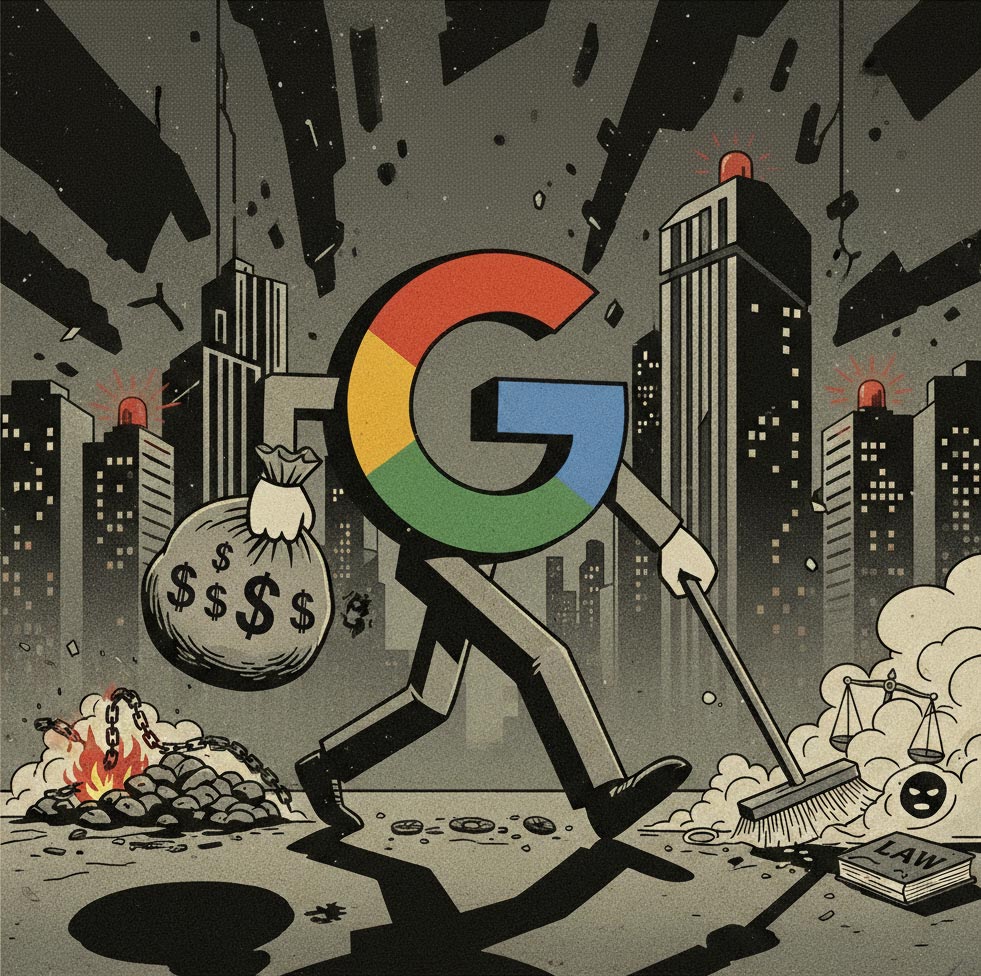
It’s like something out of a gangster film. The kingpin is finally cornered, the evidence is overwhelming, and the verdict comes down: Guilty. But then, in a stunning twist, the judge looks at the mountain of plunder and tells the robber he can keep most of it. In fact, he just needs to write a thank-you note. This isn’t fiction.
September 29, 2025, 11:18 am
By Greg Brailsford
It’s like something out of a gangster film. The kingpin is finally cornered, the evidence is overwhelming, and the verdict comes down: Guilty. But then, in a stunning twist, the judge looks at the mountain of plunder and tells the robber he can keep most of it. In fact, he just needs to write a thank-you note.
This isn’t fiction. This is the reality of the American justice system when it comes to corporate power. Last month, after years of investigations and a landmark trial, Obama-appointed Judge Amit Mehta, who had already found Google guilty of maintaining an illegal search monopoly, handed down his penalty. It was, to put it mildly, a joke.
Google will not be forced to sell off its key levers of power, like the Chrome browser or its Android operating system. Instead, they got what critics across the political spectrum are calling a “slap on the wrist.” The company that asphyxiated the open internet will be allowed to keep its empire intact.
“You don’t find someone guilty of robbing a bank and then sentence him to writing a thank you note for the loot,” said Nidhi Hegde, executive director of the American Economic Liberties Project.
Tim Sweeney, the CEO of Epic Games, which has fought its own antitrust battles against Big Tech, put it even more starkly. “It’s like a defendant robbed a series of banks and the court verdict found them guilty, then sentenced them to probation under which they may continue robbing banks but must share data on how they rob banks with competing bank robbers.”

The ruling was so toothless that Wall Street celebrated. Shares in Alphabet, Google’s parent company, shot up 9% as investors breathed a sigh of relief. The message was clear: crime pays, as long as you’re big enough. Sundar Pichai, Alphabet’s CEO, was so confident that he essentially declared the whole ordeal “over.” Within two weeks, Google was back to its old tricks, leveraging its monopoly power to dominate the next frontier of generative AI.
The court’s remedy, as one analyst noted, has already failed. This isn’t a mistake; it’s a feature. This is what happens when our judicial system decides its primary role is to protect the oligarchy.
We are told to trust our institutions, to respect the “rule of law.” But what we are witnessing is the codification of a two-tiered justice system. Even when faced with a guilty verdict, judges like Mehta go out of their way to protect corporate monarchs. In his ruling, Mehta spoke of showing “humility” and not acting as a central planner. But this is a false humility. It is not deference to the law, but deference to power. As Matt Stoller of the anti-monopoly newsletter BIG points out, the judge showed humility “to a monopolist granted power by some sort of divine or metaphysical force.” The Divine Right of Google.
In a particularly galling move, Mehta refused to include an anti-retaliation provision in his remedy. This means Google is legally free to take revenge on the smaller companies and individuals who bravely testified against it. The court didn’t just fail to punish the monopolist; it left the monopolist’s victims exposed to its wrath.
This is part of a disgusting pattern. For decades, our courts, all the way up to the Supreme Court, have routinely discarded evidence, twisted constitutional law, and delivered nonsensical rulings to shield large corporations from any real accountability. They have invented doctrines that serve no purpose other than to protect entrenched power.
Why does this matter? Because rulings like this are extraordinarily dangerous. They send an unmistakable signal to every boardroom in America: go ahead, break the law. Crush your competitors, deceive your customers, build your illegal monopoly. If you get caught, the worst you can expect is a theatrical rebuke and a fine that amounts to a rounding error. The incentive to engage in illegal behavior has never been stronger.
Judge Mehta’s ruling rests on a rotten philosophy, one that has infected the Democratic establishment. He argues that as long as Google provides a useful service—the “succor” of good technology—we should tolerate its coercive power. This is the “consumer welfare” argument in a nutshell: as long as prices seem low or the product feels free, any amount of underlying coercion, manipulation, or market-rigging is acceptable. Liberty, in this view, is simply being allowed to choose from the options your corporate master provides you.
This is not liberty.
Our country was founded on a radically different idea, one enshrined in the Declaration of Independence: that all are created equal, and that legitimate power derives from the consent of the governed. It isn’t a top-down gift from a king or a CEO. It’s a bottom-up right.
That same spirit animated the original antitrust laws. When Senator John Sherman championed his landmark act in 1890, he wasn’t talking about consumer welfare. He was talking about freedom. “If we will not endure a King as a political power,” he declared, “we should not endure a King over the production, transportation, and sale of the necessaries of life. If we would not submit to an emperor we should not submit to an autocrat of trade.”
An autocrat of trade. That is exactly what Google is. And that is exactly what Judge Mehta just chose to protect. Senator Elizabeth Warren was blunt: “Instead of restoring competition and ending Google’s dominance, this ruling is a slap on the wrist for unlawful behavior that warranted the breakup of this tech giant.”
Leaders on both the left and the right are fundamentally comfortable with this arrangement, they just prefer different oligarchs. One side bows to the credentialed expertise of Big Tech and the corporate “regime,” the other to the charismatic authority of Wall Street billionaires and strongmen. Both visions see a world of rulers and the ruled, where liberty is something granted by a master, not an inherent right of the people. Both are horrified by a world without bosses.
But a new populist spirit is rising, one that remembers the older, truer vision of American freedom. It is the vision of anti-monopoly champions like FTC Chair Lina Khan, who believe that liberty means freedom from arbitrary coercion. It understands that you cannot have a real democracy or a functioning society when you allow corporate kings to rule our economic lives.
The fight is far from over. As it happens, another Google antitrust trial is just beginning, this one concerning its dominance over the advertising market. It will be before a different judge. We are reminded, once again, what is at stake. This isn’t just about Google. It’s about the fundamental question of our time: will we live as free citizens in a democracy, or as subjects in a corporate kingdom? Will we tolerate the arbitrary coercion of autocrats of trade, or will we have the courage to build a new politics and demand a government that serves the people, not the powerful? The answer depends on us.
Was this article of value?
We are an reader-supported publication with no paywalls or fees to read our content. We rely instead on generous donations from readers like you. Please help support us.