


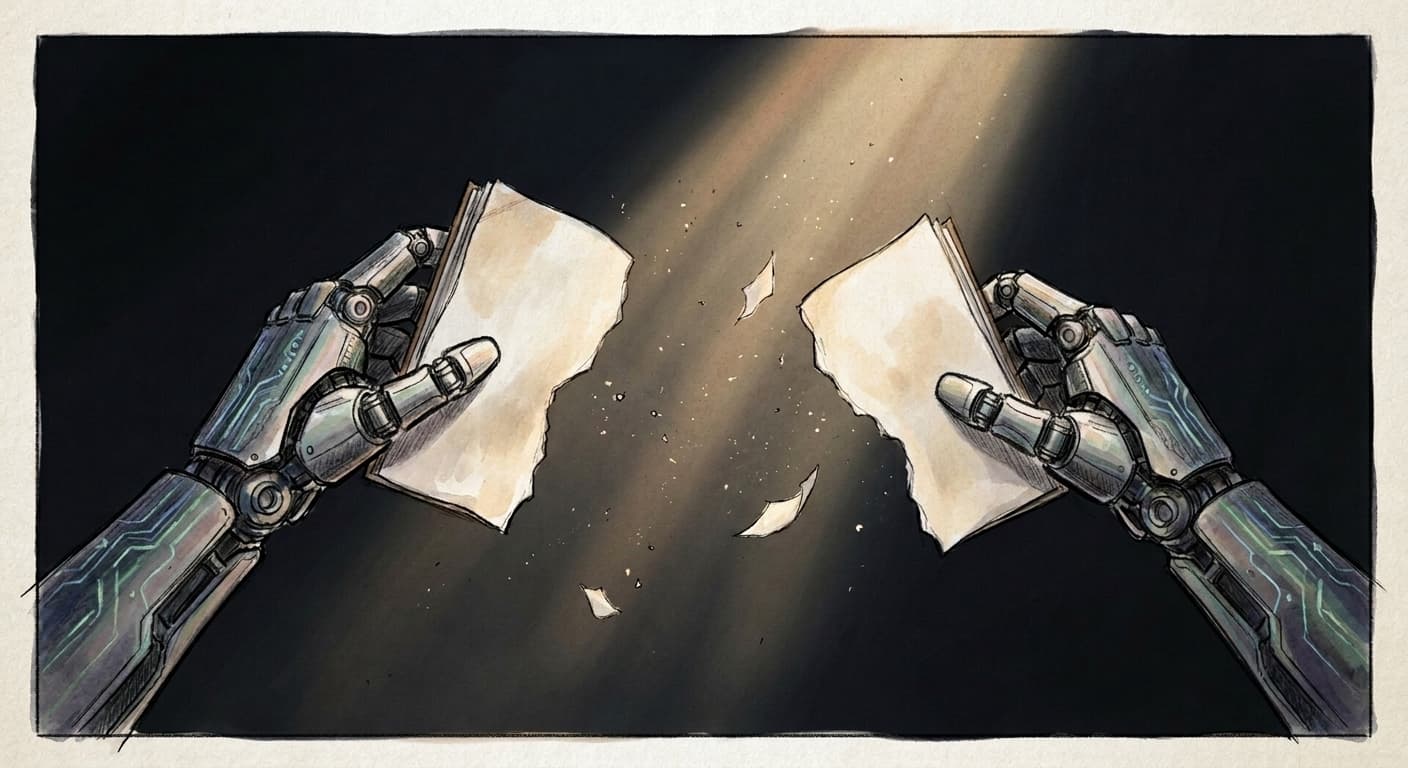
Everybody in the AI industry is accusing everybody else of stealing. Anthropic says a Chinese startup lifted the guts of its flagship model. The White House backs that up with talk of sanctions. And in the same stretch of days, a federal judge signed off on the largest copyright settlement in American history — against Anthropic itself, for the way it built that very model in the first place.
The accusation landed July 22, when Michael Kratsios, the White House's director of science and technology policy, posted that Moonshot AI "distilled Anthropic's Fable for the development of its K3 model." Moonshot released Kimi K3, a 2.8-trillion-parameter open-weight model, on July 16, and it was popular enough that the company briefly paused new subscriptions. Treasury Secretary Scott Bessent followed with a warning of his own: "Open source is not open season on American IP," he wrote, adding that sanctions and Entity List designations remain on the table. Undersecretary of State Jacob Helberg called it "a heist of invaluable American Intellectual Property" and "industrial espionage."
Distillation, in plain terms, means training a smaller model to imitate the outputs of a bigger one. It's a normal, legal technique at small scale — engineers do it all the time. What the administration alleges is something bigger: an industrial-scale operation to strip Fable's capabilities and pour them into a Chinese competitor. Neither the White House nor Anthropic has published logs, training records or any forensic package to prove that Fable's outputs actually ended up inside K3. Moonshot has not responded to questions about how it trained the model.
Local sponsorWorld-class website design at a small business priceCompany 50Even researchers sympathetic to the concern aren't sold on the mechanics. Braden Hancock, a researcher at the Laude Institute and co-founder of Snorkel AI, told TechCrunch he doubts a model this capable came together this fast through distillation alone. "I don't think you get a model this strong and this quickly on the heels of Fable doing strictly distillation," he said. "You can't distill that much data, train a model, and release it in two weeks." Fable went public July 1. K3 shipped fifteen days later.
Here's where the timing turns awkward for Anthropic. In June 2025, Judge William Alsup ruled that Anthropic training its Claude models on lawfully acquired books was "exceedingly transformative" and protected fair use — but that downloading and stockpiling more than seven million pirated books from shadow libraries LibGen and PiLiMi to build that training library was not. He called the piracy "inherently, irredeemably infringing." That finding produced a $1.5 billion settlement, roughly $3,000 per work, covering more than 480,000 books. A federal judge granted it final approval this month, and Anthropic admitted no wrongdoing along the way.
So Anthropic argued in court that scraping copyrighted material to train a model is transformative and lawful, so long as the source material itself wasn't stolen. Now it's accusing a rival of building a model off its own outputs and asking Washington to treat that as theft. Kevin Bankston, a senior advisor on AI at the Center for Democracy and Technology, put it bluntly to the Daily Caller: distillation doesn't necessarily violate copyright at all, and the labs' objections are "incredibly hypocritical" and "rather inconsistent with their fair use arguments in cases about their scraping data for AI training."
That's not to say the two situations are identical. Training on copyrighted books and copying a rival's model outputs raise different legal questions, and critics on both sides agree that nobody in Washington has laid out a clear legal theory for why Moonshot's alleged conduct would be illegal. But the contrast is hard to miss: Anthropic spent a year building its brand as the industry's loudest voice against unauthorized model copying, while quietly writing a $1.5 billion check for doing something adjacent to what it's now calling theft. Kratsios made his accusation in a single social media post. Anthropic still hasn't published the evidence behind it.