


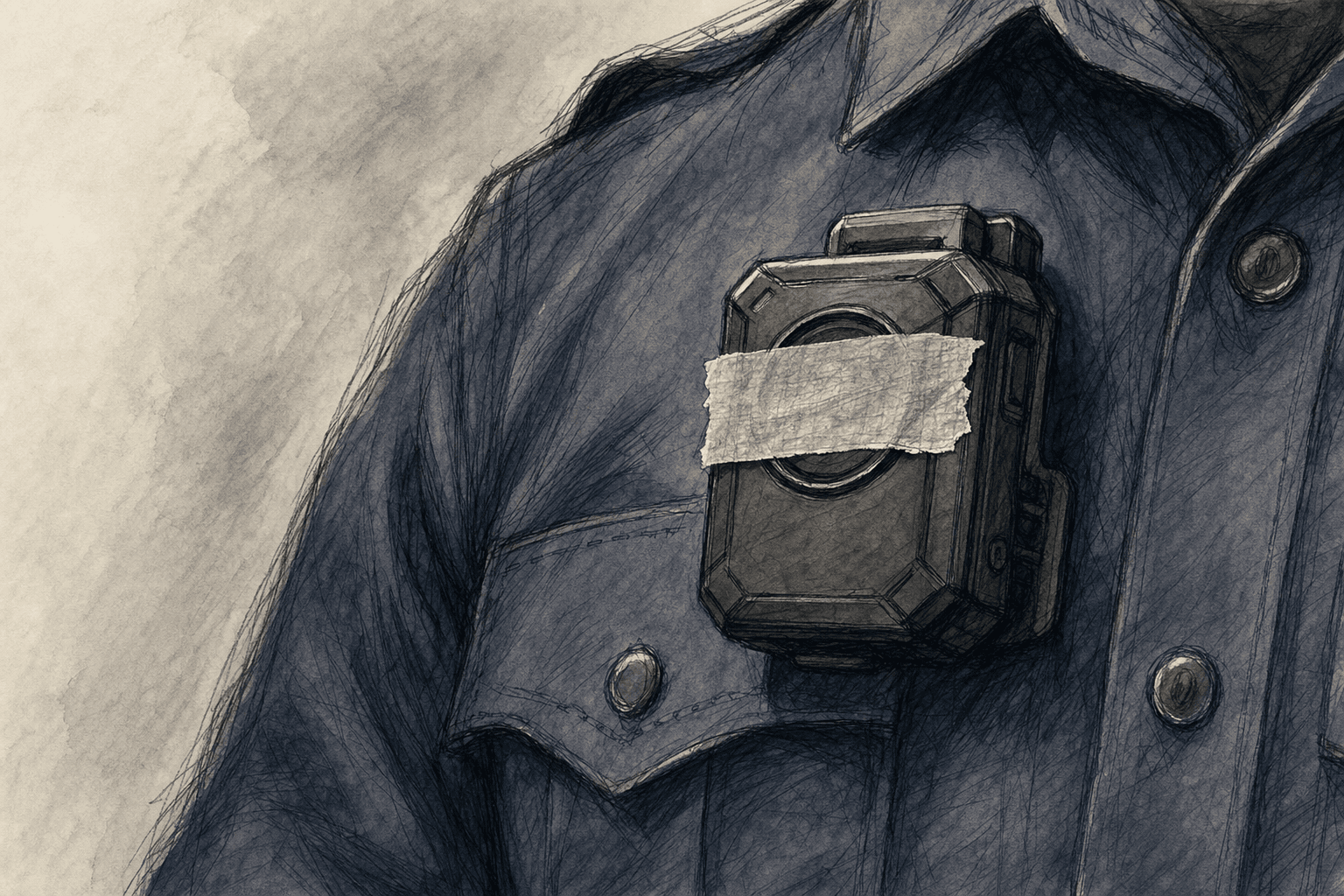
On July 14, standing in front of a CNN camera and pressed by Kaitlan Collins about why the Immigration and Customs Enforcement officers who had killed two men in the space of a week were not wearing body cameras, White House border czar Tom Homan gave an answer that had the virtue of being simple and the defect of being contradicted by his own government's paperwork: as soon as ICE had the funding, he said, they bought them.
Three days later, on July 17, and again on July 20, ICE issued delivery orders for $30.9 million in body cameras from Axon Enterprise — the sole-source vendor that has supplied the agency's cameras and Tasers for years. That is the sequence, and the sequence is the story. The purchase came after the claim that the purchase had already been made.
Federal contracting documents obtained and published by Judd Legum's Popular Information newsletter lay out the rest of the arithmetic. President Trump signed the Department of Homeland Security appropriations bill containing $20 million earmarked specifically for body cameras on April 30. In the eleven weeks between that signature and the July 17 delivery order, DHS spent $75,000 on new body cameras — roughly a third of one percent of the money Congress handed it for the purpose. The authority to buy up to $100 million worth of Axon cameras has existed since 2023. And on July 4, 2025, Trump signed the reconciliation package that gave ICE $75 billion in additional funding with few strings attached, money no government shutdown touched.
Local sponsorWorld-class website design and custom software at a small business price.Company 50I have covered enough budget cycles on Smith Hill to know that "we didn't have the money" is the most durable excuse in government, and the most testable. Here the test is failed on the documents.
Why should any of this matter on a Thursday in Rhode Island? Because from January 2025 through March 10 of this year, ICE made nearly 700 arrests in this state, and not one of the officers making them was reliably recording what happened. The gap is not theoretical here. On January 15, agents were seen running into the Garrahy Judicial Complex in Providence. Last November, ICE agents wrongly targeted a Rhode Island Superior Court intern — a high school student they had misidentified — and, as Senator Jack Reed described it in condemning the episode, surrounded a judge's car, ordered everyone out, and threatened to smash the windows if they did not comply. Representative Seth Magaziner, ranking member of the House Homeland Security subcommittee on counterterrorism and intelligence, called the intern's detention a disregard for civil liberties. In each of those encounters, the only account of what agents did is the account the agents give.
ICE's own policy says it should be otherwise. Directive 19010.3, reissued in February 2025 and preserving nearly all of the Biden-era language it replaced, requires officers to activate body cameras during enforcement activity — arrests, warrant executions, deployments to federal facilities — and requires a written explanation when they do not. The directive carries one qualifier that swallows the rest: "Enterprise-wide implementation shall be dependent on availability of appropriated funding resources." Testifying on Capitol Hill in March, then-Acting ICE Director Todd Lyons put the real number on the record — roughly 3,000 of ICE's 13,000 officers had been issued cameras. Less than a quarter.
The consequences arrived this month. Lorenzo Salgado Araujo, 52, was shot and killed by an ICE officer in Houston on July 7 while driving a work crew to a construction site; ICE said he used his vehicle as a weapon, an account the three men detained with him dispute. Six days later, on July 13, ICE officers in Biddeford, Maine, executing a search warrant that did not name him, shot and killed Joan Sebastián Durán Guerrero, a 25-year-old Colombian food delivery driver who was legally authorized to work and checking in regularly with immigration authorities. DHS said he attempted to flee and that an officer fired fearing for public safety. No officer in either shooting was wearing a camera. Durán Guerrero was the eighth person killed in federal immigration enforcement actions in this administration; in exactly one of those eight cases was an agent recording.
To be fair to Homan, he has consistently offered a reason beyond money: that ICE needed time to hire staff, build storage capacity, and brace for the flood of public records requests that footage invites. That is a real administrative burden. It is also not what he said on July 14, and it does not explain three years of unexercised contracting authority.
Rhode Island's Senate did what a state legislature can do. On June 5 it approved two bills from Senate Majority Leader Frank Ciccone restricting state and local cooperation with federal immigration enforcement and opening the door to lawsuits against federal officers. Providence Mayor Brett Smiley signed an executive order on January 20 barring immigration enforcement from city property — parking lots, schools, parks, municipal buildings. Neither a state statute nor a mayoral order can put a camera on a federal officer's chest.
DHS says cameras have reached more than half its field offices and that the rest will follow by September. Homan says trainers are being trained. That is the promise now on the table, and it is the one worth marking on the calendar: the cameras ordered on July 17 were paid for with money appropriated in April, spent in July, for encounters that happened in January — the accountability equivalent of putting the water on to boil after the guests have finished eating.