


The Middletown Conservation Commission spent most of its July 30 meeting hearing from staff of Aquidneck Resilience, a climate planning effort funded by a $2 million federal grant, and collecting members' priorities for an islandwide climate resilience plan now being drafted.
The session was billed as a special meeting, and the chair, Melissa Welch, said she had invited members of the Middletown Tree Commission and the town's open space committee to join. Four commission members were present, which Welch said established a quorum — the minimum number of members needed to conduct business.
Minutes approved
The commission approved minutes from its June 24 meeting by voice vote, with no discussion. Welch said those minutes include a memo the commission sent to the Planning Board about a residential project it reviewed, and that the Planning Board is expected to take the project up in August.
The grant, and what it is supposed to produce
Emma Polinsky of Aquidneck Resilience described the organization as a collaboration among Newport, Middletown and Portsmouth, along with Naval Station Newport, hosted by the Aquidneck Island Land Trust. She said the work is paid for with a $2 million grant awarded in 2024 by NOAA, the National Oceanic and Atmospheric Administration, running through 2028, and that the project is one of 18 nationally.
Local sponsorAffordable photography lessons in Newport, Jamestown, or your town.E.L. Photo RIStaff said the grant pays for five additional staff members who can take on resilience projects for towns that have money but not the people to run them. They also described a "gap analysis" — a review of plans a community already has, to find recommendations that were never carried out. One Middletown example cited was the West Main Road redevelopment plan in the town's capital improvement plan, where the identified gap was weak coordination between the town and the Navy over adjacent military property.
The presenters asked commission and committee members to fill out a roughly 10-minute public survey, and asked them to set aside feasibility and name projects they would want funded over the next decade.
What members said they would spend it on
The discussion that followed was the substance of the meeting, and it was frank about what the town cannot currently enforce.
A Tree Commission member said Middletown's tree canopy is low because of its farming history, and that the western part of town is effectively a tree desert, shaped in part by the Navy base, the airport, golf courses and older, smaller-lot neighborhoods. She said the commercial stretch of West Main Road has essentially no trees, and that the town has doubled the Tree Commission's funding over time while grant money for tree planting has become harder to find.
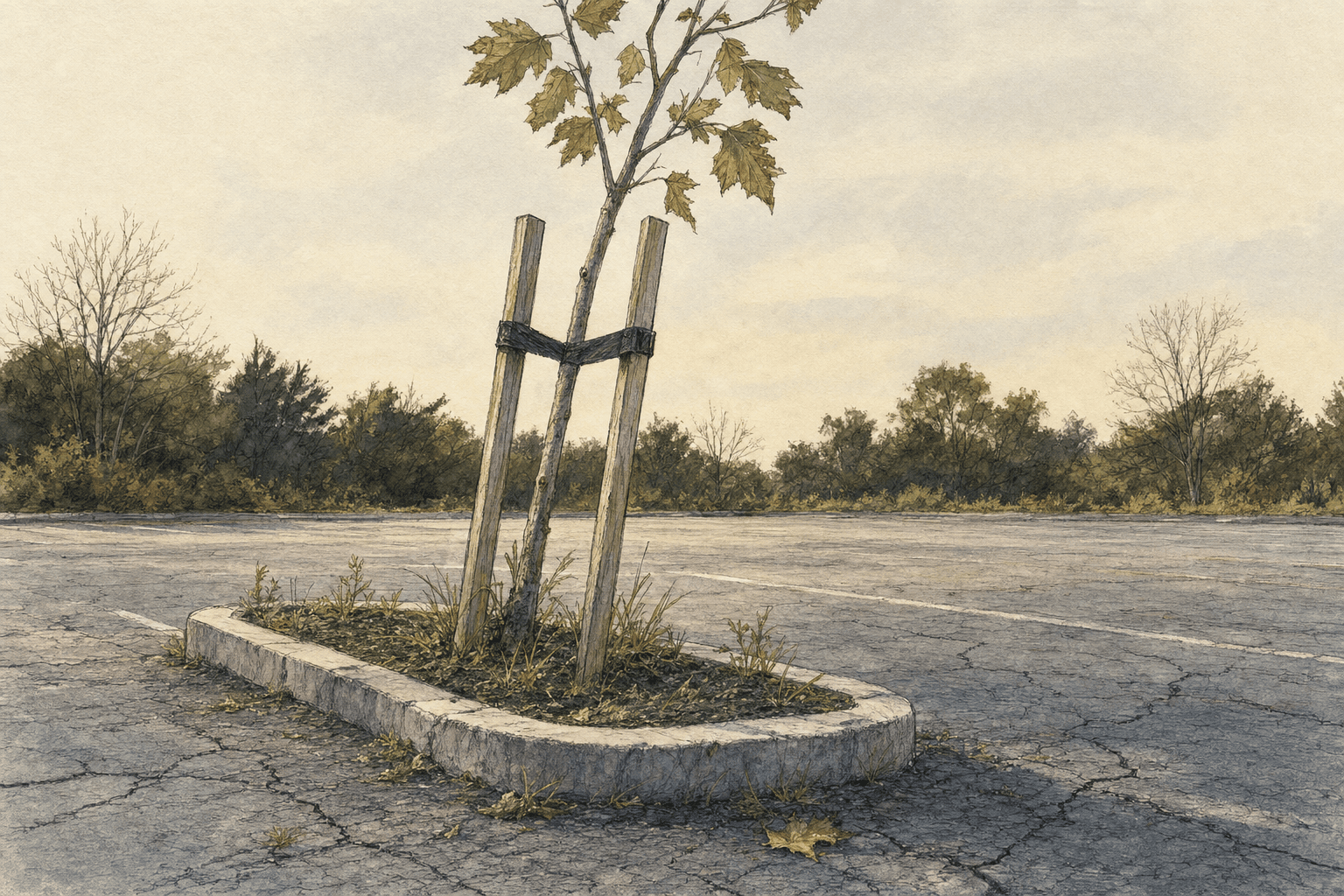
Members described a recurring enforcement problem: landscaping plans approved as a condition of development do not always survive. One Tree Commission member said trees approved for a commercial parking lot years ago died after the planting islands were filled with rock, and the islands were later paved over. She said the commission now asks for a maintenance plan with every project, but that enforcing one a decade later, after the developer is gone, remains unresolved. Members said the town is generally reluctant to pursue developers over landscaping unless a violation is severe.
The Planning Board's representative to the commission said his own priority would be bike lanes, sidewalks and separated paths along East and West Main Road, and zoning changes such as eliminating minimum parking requirements that force large asphalt lots. A member of the open space committee said the state's ownership of East and West Main Road, and Navy ownership on the west side, have repeatedly blocked bike connections.
Nick Coogan, a member of the public formerly with the town's open space committee, said a short walking and biking connection near the western edge of town cannot be cleared because the Navy will not release its property piecemeal while contamination questions remain. He also described work on Dunlap-Wheeler Park, where the town hired a consultant to study making the park more resistant to saltwater flooding; he said the potential funding was gone by the time the review was finished.
Karen Day of the Middletown Tree Commission said she would spend money educating the town and state about phytoremediation — using plants to draw contaminants out of soil. She said the Tree Commission was recently quoted roughly $20,000 to remediate about three cubic yards of soil at a town park where it wants to plant more trees.
Welch also pointed to a fertilizer and pesticide measure the town adopted as a policy rather than an ordinance, which she said carries no enforcement mechanism and assigns no one to do the education and outreach it describes.
Liaison report and membership
Philip Roberson, the commission's vice chair and its liaison to the Middletown Tree Commission, reported on Tree Commission review of a development near Town Hall, including plant selection and a request to connect the site to a long-discussed pathway.
The commission is down to four members. Mike Fenton, the secretary, said his term ended the day after the meeting and that he notified the town clerk he will not seek reappointment, but offered to stay until replacements are found. Welch said she has applied for reappointment and expects appointments to go before the Town Council, with officer elections to follow.
The commission adjourned by voice vote. Residents interested in serving were urged to apply to the town.