

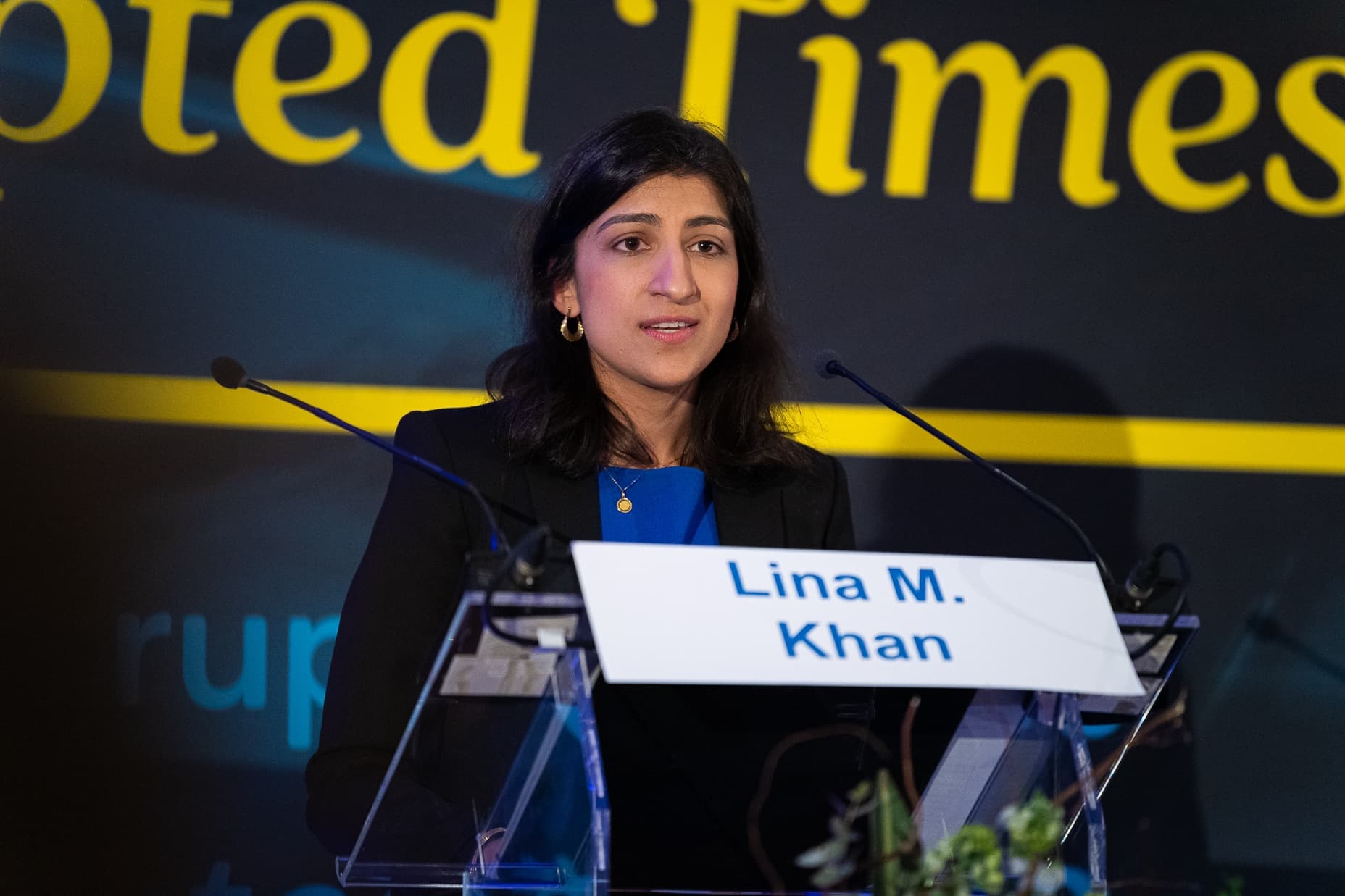
In a nation where corporations wield unprecedented power, one woman stands as a true fighter for consumers and workers alike. Lina Khan, the 35-year-old chair of the Federal Trade Commission, has become a thorn in the side of Big Tech and corporate America. But her crusade against monopolies and unfair business practices might be cut short if certain political forces have their way.
Khan's rise to prominence began with a groundbreaking law review article she wrote as a student, challenging the conventional wisdom on antitrust law. Her argument that companies like Amazon were exploiting loopholes to build unchallenged monopolies caught the attention of policymakers and ultimately led to her appointment as FTC chair by President Biden in 2021.
Since taking the helm, Khan has wasted no time in shaking up the status quo. Her aggressive approach has yielded tangible results for consumers and workers and earned her praise from progressives and conservatives, who see her as a champion for the little guy in a system that often favors big business. Even Donald Trump's VP, JD Vance, said, "A lot of my Republican colleagues look at Lina Khan … and they say, ‘well Lina Khan is sort of engaged in some sort of fundamental evil thing. And I guess I look at Lina Khan as one of the few people in the Biden administration that I think is doing a pretty good job." Here are some specific examples of actions the FTC has taken under Khan:
- Blocking harmful mergers: Under Khan's leadership, the FTC successfully challenged several high-profile mergers that could have reduced competition and harmed consumers. For instance, the agency's lawsuit against Nvidia's $40 billion acquisition of Arm Ltd. led to the deal being abandoned. This action helped preserve competition in the crucial semiconductor industry, potentially keeping prices lower for consumers and fostering innovation.
- Taking on Big Tech: Khan's FTC filed a landmark antitrust lawsuit against Amazon in 2023, accusing the e-commerce giant of illegally maintaining its monopoly power. The case, set for trial in 2026, could potentially reshape the tech industry landscape and create more opportunities for smaller businesses to compete.
- Protecting gig workers: The FTC has taken steps to safeguard gig economy workers from exploitative practices. In one case, the agency ordered Amazon to pay $61.7 million to settle charges that it withheld tips from Amazon Flex drivers.
- Combating junk fees: Khan's FTC proposed a rule to ban hidden and deceptive fees across various industries, from concert tickets to hotel bookings. This action could save consumers billions of dollars annually.
- Cracking down on deceptive practices: The agency secured a $520 million settlement with Epic Games, the maker of Fortnite, over allegations of deceiving players into making unwanted purchases and using dark patterns to deter cancellations.
- Tackling anti-competitive practices in healthcare: The FTC successfully blocked a $365 million merger between Rhode Island's two largest healthcare providers, Lifespan and Care New England. This action helped preserve competition in the state's healthcare market, potentially keeping costs down for patients.
- Protecting children's privacy: Under Khan's leadership, the FTC has taken strong action against companies violating children's privacy online. For example, the agency fined Epic Games $275 million for violating children's privacy law and forced the company to adopt strong default privacy settings for young users.
- Fighting unfair non-compete agreements: Khan's FTC proposed a rule to ban non-compete clauses, which affect roughly 30 million American workers. This action could increase worker mobility and wages across various industries.
- Challenging pharmacy benefit managers (PBMs): The FTC sued the largest PBMs in the country, accusing them of artificially inflating insulin prices. This action could potentially lead to lower drug costs for millions of Americans.
- Protecting consumer data: The agency has taken steps to limit how companies collect and use consumer data. For instance, it fined Twitter $150 million for deceptively using account security data for targeted advertising.
These actions demonstrate Khan's commitment to using the FTC's authority to protect consumers and promote fair competition across various sectors of the economy. Her approach represents a stark departure from decades of lax antitrust enforcement. Since the 1980s, regulators have largely taken a hands-off approach to corporate consolidation, focusing narrowly on consumer prices rather than broader impacts on competition and market structure. Khan argues this approach has led to a host of problems, from stagnant wages to reduced innovation and choice for consumers.
Khan's supporters say her aggressive stance is long overdue. Senator Bernie Sanders praised her as "the best FTC Chair in modern history," adding that she's "finally doing what should have been done decades ago." Representative Alexandria Ocasio-Cortez has also come out swinging in Khan's defense, warning of an "out and out brawl" if there are attempts to remove her from office.
But not everyone is a fan of Khan's approach. Critics, including some prominent tech investors and executives, argue that her aggressive stance on mergers and acquisitions is stifling innovation and hurting America's global competitiveness, especially in areas like artificial intelligence. Mark Cuban, while praising some of Khan's work, has suggested that her scrutiny of tech companies could harm America's ability to lead in AI development.
The debate over Khan's future has become entangled with larger political considerations. As Vice President Kamala Harris courts monetary support from business leaders for her presidential run, some donors are pushing for a more business-friendly approach to regulation. This has led to serious concerns that Khan could be replaced if Harris were to win the presidency.
However, such a move would likely face fierce resistance from the more progressive wing of the Democratic Party. Ocasio-Cortez's warning of a "brawl" if Khan is removed highlights the potential for intra-party conflict over the direction of economic policy.
The stakes of this debate are high. Khan's supporters argue that her work is crucial for addressing the root causes of many economic issues facing Americans today, from high prices to lack of choice in many markets. They point to examples like the FTC's crackdown on pharmacy benefit managers as evidence of the real-world impact of her approach.
Khan's tenure at the FTC has also shone a light on the human cost of corporate consolidation and unfair business practices. Take the case of Deborah Brantley, a former bartender who found herself trapped by a non-compete agreement after leaving a job where she alleged sexual harassment. Khan's proposed ban on such agreements could prevent similar situations in the future, giving workers more freedom to leave abusive workplaces without fear of legal repercussions.
As the 2024 election approaches, the future of antitrust enforcement in America hangs in the balance. Will Khan be given the opportunity to continue her work, potentially reshaping the American economy to be more fair and competitive? Will Trump heed the words of his VP and keep Khan onboard? Will Harris ignore the tens of millions of dollars donors have given her under the guise that she dump Khan?
What's clear is that the debate over Khan's tenure goes far beyond just one person or one agency. It's a referendum on how we as a society want to address corporate power and economic fairness. As Khan herself puts it, her work is about "enforcing the law" and ensuring that "upstarts and disrupters and tinkerers have a fair shot at competing."
In a time of growing economic inequality and corporate consolidation, Khan's efforts to level the playing field have never been more crucial. Whether she'll be given the chance to see her vision through remains to be seen. But one thing is certain: the impact of her work will be felt for years to come, shaping the future of American capitalism in ways both big and small.