


Whenever Josh Fenton and Kate Nagle give their slanted coverage to Providence Public Schools and various fiascos on different campuses, they are apt to include mention of the school’s dismal Math and English Language Arts (ELA) scores. Besides the blatantly racist, xenophobic, and stigmatizing condescension of it all, there is also the flagrant lack of due diligence that regrettably fails to interrogate the underlying structural shortcomings that generate such blatantly racialized disparities.
As a classroom teacher who has nearly a decade of experience in Providence, I can testify to how grotesque the GoLocal News Team truly is.
Understanding What Our Kids Need
I have taught in multiple classrooms where I have students that are completely competent and capable in their English comprehension sitting beside students who just got off the plane from Dominican Republic last Friday. Providence does not have segregated cohorts where English as a Secondary Language (ESL) students are put into siloed classes with only ESL teachers and students (in fact, this was strictly prohibited by an Obama-era settlement between the District and the Department of Justice over a civil rights lawsuit).
Language acquisition is an extremely complex science that is governed by a multiplicity of variables.1
But for our purposes, it is fair to say that a middle school student can take as long as two years to reach a level of rudimentary fluency where they can both understand the language but also make multiple grammatical and vocabulary errors in conversation. It can take five years at a minimum for a student to reach proficiency necessary to turn in an English book report without grammatical, spelling, and academic language errors.
And so, let us consider the racist statement made by GoLocal in their coverage last week about a principal’s spouse ending his stint volunteering at Juanita Sanchez High School, where they said “only 28% of students meet expectations in English Language Arts, and 8.9% in math.”
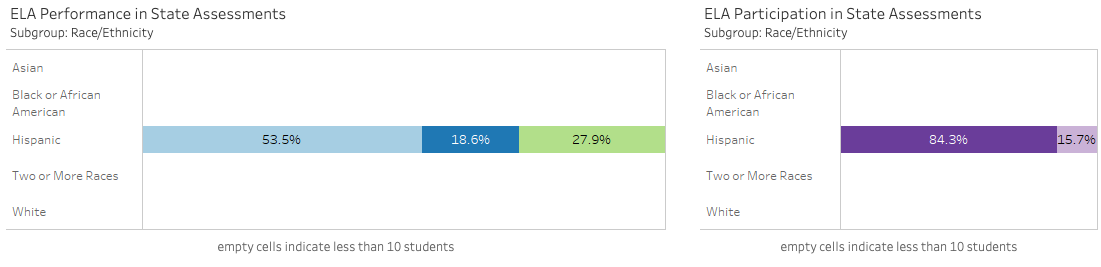
As you can see from the actual dataset on the RIDE website, GoLocal cherry-picked this set of stats through aggregation of all students, including ESL students so as to reduce the performance rate. Here are the real stats for the school, properly presented to dis-aggregate ESL students who otherwise significantly lower the school scores artificially by the design of GoLocal.
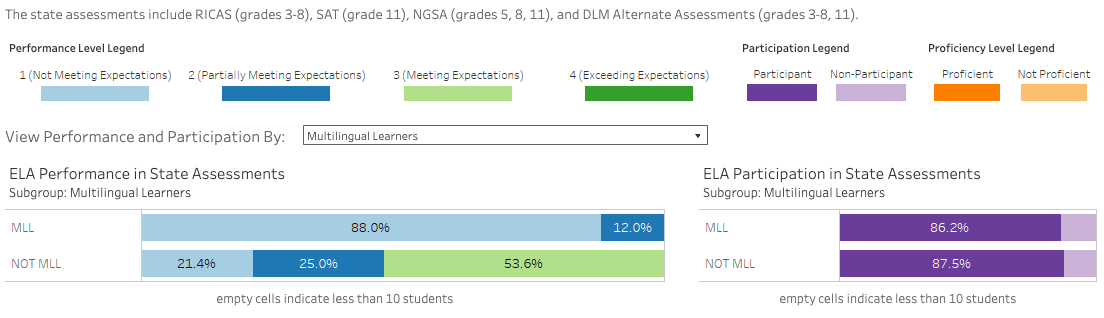
According to this corrected statistic, over half the students at Sanchez meet expectations for the state assessment. Fenton and Nagle lied in the most transparent manner possible and any Faculty member, Administrator, or student family member with a rudimentary grasp of the RIDE website’s user interface can obviate this fraudulence.
In essence, GoLocal makes hay by shaming and blaming Latino kids over language disparities using doctored statistics and flawed metrics.
How many other news columns featured doctored statistics that so fundamentally diminish and dilute the accomplishments of Providence students, the majority of whom are Latin American, African American, or Southeast Asian?
Regrettably, the website architecture of GoLocal is not optimized with a sufficient search engine and cross-referential database so one might be able to aggregate and examine every single news story that ever reported on District ELA scores, meaning we might have a decade of shoddy reporting on hand that has never been adequately audited by a journalistic ombudsman.
Our kids need a lot in terms of support, and that includes a press that does not misrepresent and racially stigmatize them in service of shoddy reporting and a political agenda.
Before the State Takeover
In December 2015, I was hired as a per diem substitute teacher in Providence, $100 per day with no benefits.
In the following year, I took on a position that had remained unfilled at one of the middle schools. I taught three groups of ELA students with Secondary Language learning needs, meaning I taught these students ELA in one class and English as a Secondary Language (ESL) in another.
The curriculum materials used were noteworthy. For the ESL curriculum, we were given National Geographic’s Inside/Cengage materials, which continue to be used in the District today. For ELA, we used the StudySync curriculum from McGraw-Hill, which is used in multiple Districts across the state.
The beauty of StudySync was that it provided a textbook alongside a computer testing module. This is vital because the assignments could be automatically customized by the computer program to augment the reading level of each student.
Let me explain in a simple example using an eighth grade classroom: Carlos is fresh from the Dominican Republic and has entered the Intermediate “social fluency” phase, equivalent to second grade. By contrast, Amy is a US-born national reading at grade level. The two students are both assigned the same book reading from StudySync and it was read aloud in class. After the reading, the students were given a computer-based quiz. Amy’s test was written at her grade-level fluency standard while Carlos was given a test at his second grade level. This is known as scaffolding and is a normative component/expectation for public education. (While it might come across as stigmatizing, the TESOL endorsement and ESL education is a form of Special Education according to Rhode Island and federal education law. Scaffolding assignments for special education is part of a distinct class that you are required to take in order to earn your teaching license.)
StudySync was imperfect but it got the job done. The students could get scaffolded assignments that automatically were graded and input into the grade book, a huge benefit when you remember that your average middle or high school teacher can have up to 30 students on each of their five daily period rosters, ie 150 individual students. It is logistical insanity to not rely on either traditional Scan-Tron bubble sheet testing or computer-based modules when teaching that many students, especially in a complex discipline like language acquisition.
After the State Takeover
First, it is important to remember that the Takeover took place at the exact same moment as the COVID-19 lock down. Whilst seemingly peripheral, it is in fact necessary to recall Naomi Klein’s dictum from her classic The Shock Doctrine, “Don’t let a good disaster go to waste.” Throughout her book, Klein outlines the basic coordinates of how unpopular government measures (austerity, privatizations, no-bid contracts for public assets and services, etc.) are implemented via distraction by disaster, what she calls “disaster capitalism.”
While the voters are distracted by something terrible like a hurricane (New Orleans after Katrina) or a tsunami (2004 in Sri Lanka), the private sector and the government enact a rapid-fire series of measures that the public would never accept otherwise. As a result, New Orleans became the first all-charter school district with no public schools in operation still to this day.2 Meanwhile in Sri Lanka, the public beaches that had been home for poor fishermen and their boats were sold off to private resort interests, destroying the indigenous fishing industry that subsisted on their catch not only for wages but also their daily diets.
Former Gov. Gina Raimondo, current Gov. Dan McKee, and Education Commissioner Angélica Infante-Green were very sure to take advantage of the COVID lock down. They threw out the pre-existing and extremely useful curriculum (along with all the perfectly decent textbooks) so to implement the American Reading Company (ARC) system.
ARC is marketed to educators and Districts as a Montessori-styled curriculum. Given the undeniable fact everyone at least admits respecting the Montessori model,3 it sounded good when it came to town.
But the devil is always in the details...
Read part 2 of this two-part editorial here.
1 I began taking classes for the necessary Teaching English to Speakers of Other Languages (TESOL) endorsement on my teaching certificate and you end up reading the non-political writings of Noam Chomsky, the ones where he invented an entirely new field of linguistics and his theory of the generative grammar. To say the field is complex would be criminal understatement; the foundational readings necessary for the introductory classes were nearly indecipherable. I have spent my entire life as an unrepentant book worm, to the point I can handle a play by Shakespeare without too much external support; these readings successfully transform sentences into complex formulae resembling trigonometry equations. If Shakespeare was Algebra I, TESOL was particle physics.
2 Incidentally, a professor at Providence College with knowledge of these policy measures indicated in a classroom discussion that Commissioner Infante-Green had clearly decided implement the playbook originally devised for New Orleans. It is vital to grasp the consequences for Rhode Island as an entire state. The re-segregation of schools in Providence would attract white, middle class, and more conservative voters to the high-rise apartments built in the past decade. In Louisiana, this meant that New Orleans contributed a significant amount of Republican votes to the Congressional and Presidential elections, something that was first embodied by the Governorship of Bobby Jindal. After generations of solid Democratic Senators, the state is now represented by two hard-right Republicans, Bill Cassidy and John Kennedy.
3 Maria Montessori’s pedagogy is a strand of Progressive Education, not too dissimilar from the theories of John Dewey and Paolo Freire, that emphasizes teaching through focus upon whatever interests the student. In Providence, the project-based learning curriculum at The Met School resembles this paradigm in some regards.