

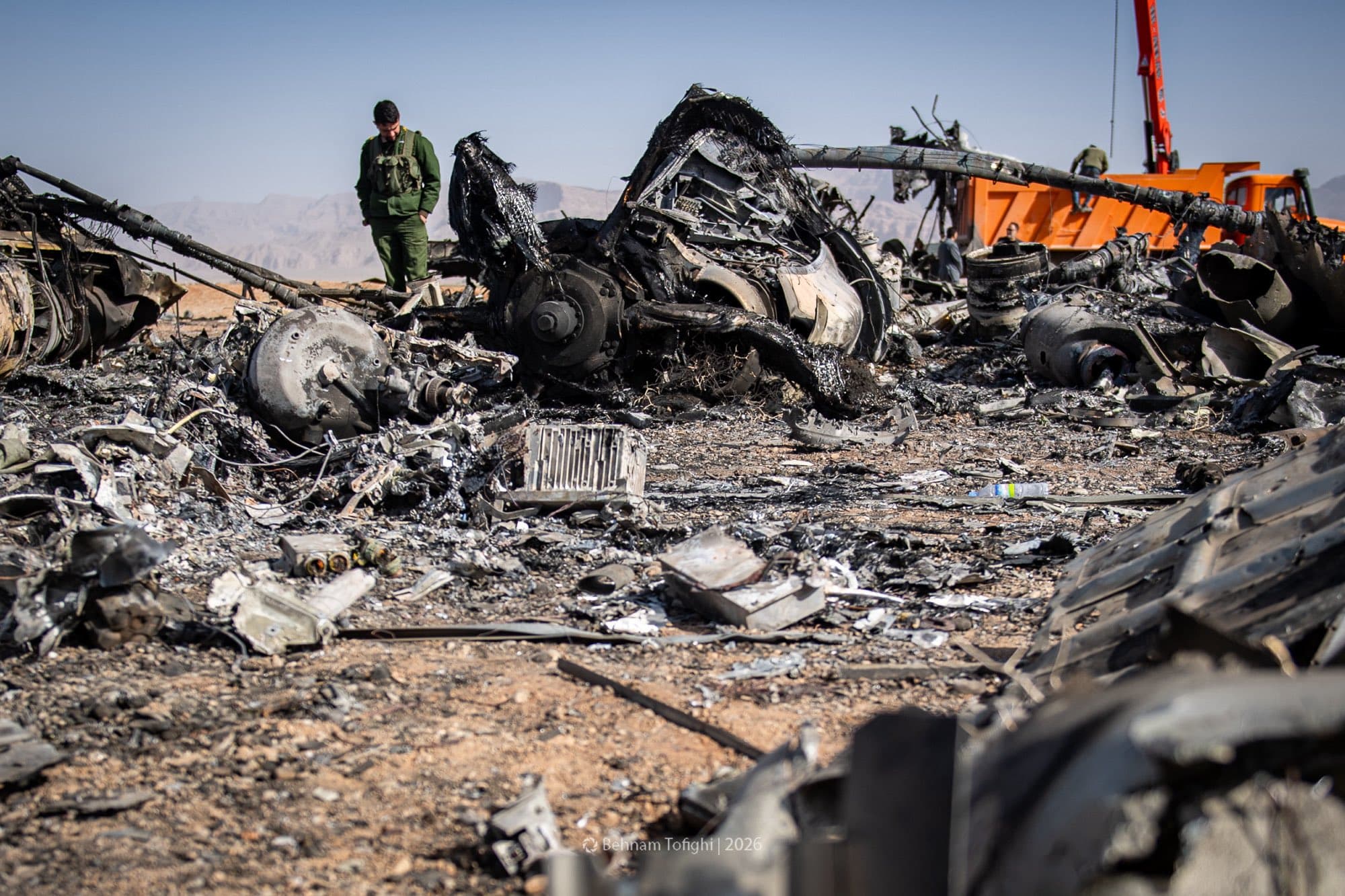
The Trump administration's account of a dramatic rescue operation inside Iran is falling apart under scrutiny — and what's emerging in its place suggests a covert mission of a fundamentally different nature, one that appears to have failed badly.
The official story begins on April 3, when an F-15E Strike Eagle was shot down over southwestern Iran. The weapons systems officer — described by Trump as a "highly respected Colonel" — ejected, was seriously wounded, and spent more than 24 hours evading capture in the Zagros Mountains, allegedly hiking up a 7,000-foot ridgeline and concealing himself in a mountain crevice. The CIA, deploying what Director John Ratcliffe called "exquisite technologies that no other intelligence service in the world possesses," located him. Hundreds of special forces troops then executed the extraction, establishing a temporary forward base inside Iran near Isfahan. Two MC-130J aircraft were destroyed on the ground. Three replacement aircraft flew in to complete the mission. No Americans were killed, Trump declared. Not even wounded.
There is one problem with this story. Weeks later, the administration has not released the name, photograph, unit, or any verifiable identifying detail about the rescued airman. Nor about the pilot of a second downed aircraft — an A-10 Warthog that crashed near the Strait of Hormuz the same day under circumstances the Pentagon has declined to explain. Both men, Trump assures the public, are "SAFE and SOUND." Both remain anonymous.
This is not standard operating procedure. It is the absence of evidence where evidence should exist.
Trump himself disclosed that more than 150 aircraft were involved in the operation. Combat search-and-rescue for a single downed airman whose location had already been pinpointed by satellite and CIA intelligence does not require 150 aircraft. It does not require two of the most sophisticated covert infiltration platforms in the U.S. inventory — the MC-130J Commando II, an aircraft specifically engineered to insert and extract large special operations forces into denied areas. It does not require SEAL Team 6, Delta Force on standby, a CIA deception campaign, Israeli air support, and a forward operating base established inside a country currently at war with the United States.
A standard combat search-and-rescue, even a complicated one, does not get described by senior U.S. military officials as "one of the most challenging and complex in the history of U.S. special operations."
The forward base, geolocated by open-source analysts within hours of Iranian state media releasing footage, sits approximately 35 kilometers from Isfahan's nuclear complex — where the IAEA believes roughly 200 kilograms of near-weapons-grade highly enriched uranium is stored in tunnels. This is not a coincidence of geography that the official narrative has chosen to address.
Former CIA officer Larry C. Johnson stated it directly: "The rescue operation expanded to become the desired Delta Force, JSOC, SOF, ST-6 high-risk operation to also seize the uranium in Iran; hence the need for so many operators, support, aircraft, etc. This was intended to be that operation. It failed." Greg Bagwell — President of the UK Air & Space Power Association and former senior RAF commander — raised the same question publicly, asking why MC-130Js were used at all if the sole objective was extracting one injured airman.
Iran's military drew its own comparison, calling it a direct replay of Operation Eagle Claw — the catastrophic 1980 attempt to rescue American hostages in Tehran, which ended in burning U.S. wreckage on Iranian soil. Iran displayed photographs of the Isfahan site. The debris — aircraft parts, helicopter wreckage, still smoking — is real. What destroyed it is disputed. The U.S. says American forces blew up their own aircraft to prevent capture. Iran says they shot them down. The official U.S. explanation for how two MC-130Js — aircraft built specifically to operate from unimproved terrain in hostile environments — were simultaneously disabled has shifted from "stuck in mud" to "stuck in sandy soil" to "mechanical issues."
Then there is Ghost Murmur.
In the days following the operation, the New York Post and other state media-aligned outlets reported that the CIA used a classified device called "Ghost Murmur" — developed by Lockheed Martin's Skunk Works, using quantum magnetometry and nitrogen-vacancy diamond sensors — to detect the electromagnetic signature of the downed airman's heartbeat from up to 40 miles away, allowing his precise location to be confirmed inside the mountain crevice. It is a device whose claimed capabilities seem to be inspired by the Call of Duty game franchise's heartbeat sensor.
The problem is not that quantum magnetometry is fictional. The underlying physics is real. The problem is the distance, the environment, the signal-to-noise ratios involved, and the basic reality that the airman was already carrying a Combat Survivor Evader Locator beacon — a GPS-based, purpose-built military rescue device that provides secure two-way communication and precise geopositioning for exactly this scenario. The CSEL beacon was activated. "Standard rescue beacon worked as designed" is a less compelling headline than "CIA's quantum ghost box heard his heartbeat through a mountain."
More telling: Ratcliffe, at the podium, said "exquisite technologies." He did not say Ghost Murmur. He did not say heartbeat detection. He did not say quantum magnetometry. The specific claims about Ghost Murmur trace to a single anonymous source in the New York Post. Intelligence services do not leak the names and operational details of their most sensitive collection capabilities to tabloids after successful operations. The Central Intelligence Agency — an organization that once classified the existence of the U-2 program for years — would not advertise a genuine technical breakthrough through the New York Post. The fact that the story exists in the press is, by itself, evidence against its truth.
The wreckage outside Isfahan is real. The scale of the force deployed is confirmed by Trump himself. The proximity to Iran's uranium stockpile is a matter of satellite imagery and public record. The two anonymous airmen, whom nobody has seen, remain the official justification for all of it.
Trump declared the operation proof that the U.S. has achieved "overwhelming Air Dominance and Superiority over the Iranian skies." Yet, Iran shot down the planes that started the entire episode.