
On Sunday September 16, 2018 the Providence Journal editorial was entitled "Rhode Island has Issues to discuss.” One of my readers wrote to me wondering if I was going to write a response.
Everyone who lives in Rhode Island agrees that Rhode Island has issues to discuss. But while I agree with some of the general statements the Providence Journal made such as Rhode Island schools need a lot of work, and the editorial board poses some relevant questions, it is clear that the Editorial Board of the Providence Journal has solutions for what ails Rhode Island that will make our problems worse rather than improve the situation. The Providence Journal’s proposed solutions for Rhode Island will benefit a very small percentage of the population, while pushing the rest of the population further and further behind. The rich get richer, everyone else gets poorer, the environment is destroyed, and democracy dies.
Considering the misinformation and depths of depravity revealed in the editorial I realized that I could not adequately answer the editorial in a 150 word letter to the editor. So I settled in for a long haul, and as is often the case, once I embark on such an adventure relevant tidbits began to find me. Almost immediately I stumbled upon the essay by David Leonhardt in Sunday September 16 New York Times Review section "We’re Measuring the Economy All Wrong” The next day I attended the Rhode Island Infrastructure Conference and sat through a panel discussion with Jesse Saglio, President of Commerce RI. I went up and introduced myself after the panel as a long term critic of his organization and asked if he would be willing to meet with me to discuss the Rhode Island economy. He asked me what was on my mind so I gave the elevator pitch version of the problems with relying on the medical industrial complex for economic development, and how that worked hand in glove with subsidized gentrification. I will follow up with him in the near future.
Then I received links to an article about the end of growth, mostly based on the physical realities of Planet Earth. The point was that as long as the economy keeps growing, even very serious efforts to dematerialize the economy, to delink the use of more stuff from economic growth, are not going to work. Even with the most serious dematerialization efforts in a growing economy the amount of throughput is projected to more than double by 2050. We will go from our current use of 70 billion tons of stuff each year to 180 billion tons. But lets get real, It is not likely to happen, and if we keep trying to get to 180 billion tons of throughput, there will be serious pain involved for many, many people long before that happens. Further confirmation of this slow moving disaster is that Overshoot day comes earlier each year. In 1970 when throughput was less than 50 billion tons of stuff (iron, coal, oil, foodstuffs, wood, fibers, sand, concrete, etc) the forest was much bigger, there was more soil, the population was much smaller, people did not use up all of the biological productivity on the planet each year. Now Overshoot day is in early August. People now use about 1.7 times the amount of biological productivity on the whole planet each year. And that does not even include anything for the rest of the ecosystem. We are depleting planetary resources at over 1 percent a year and the rate is rising.
The result is the total productivity of the planet declines faster each year. We see this in empty seas, mass extinctions, deforestation, and the displacement of the people who have lived on the land for thousands of years. It has been noted repeatedly that leaving the forest in the hands of the indigenous is the best way to keep enough forest healthy so that it can be a part of our climate mitigation and adaptation strategy but industrial civilization either kills or exiles the indigenous so that the resources of the land can be shoved down the industrial maw. New places to steal from are getting harder and harder to find so the price of resources continues to climb. The Earth gets poorer each year, depleting resources is called economic growth. though the only ones getting richer are the 1percent and new immigrants to cities. (And now tell us where they are going to find enough wood to build all of the new cities that are expected to hold another 3 billion people in the next 30 years).
The article on throughput was followed up by a press release from the Center for the Advancement of the Steady State Economy challenging the big DC environmental groups to a debate about the reality of Green Growth. I know how frustrating that discussion can be because many of my colleagues still think green growth is the answer or at least have a hard time imagining the alternatives. Those with a mainstream American perspective on the economy find the end of growth abhorrent, but reality bites. I understand how the Green Growth meme evolved, and the ways my colleagues navigate the issue is shaped by American politics, but the emperor has no clothes. Most of those who live in the industrial world are getting poorer and most of what is called profit is simply depleting the planet’s capital stock. How else did Donald Trump and the fascist/populists in Europe win? There are places that really need to see their economies grow, otherwise folks starve, but do not expect them to eat better unless the rich world reduces its consumption. The only way to call what is prevalent in the older industrial west a growing economy is to consider the cost of fixing all the disasters that are being caused or facilitated by inhumane treatment of the planet and forest communities as an addition to the economy,rather than as a loss to the world. Is this really growth or just cooking the books (as well as the planet)? (See: here and here.)
Something that would help us along the way is Full Cost Accounting. Researchers and the government already collect and analyze a vast array of data, but the current reporting of economic statistics only reports what is useful to the ruling class, In any case it should not be controversial to deduct from the societal balance sheet the money spent repairing all of the damage that human beings have caused or facilitated. If the information that does not reinforce the idea that neo-liberalism and empires are be greatest thing since sliced bread was broadcast as much as the information that supports the rulers rule was broadcast, the public would have better information, the public debate would be more useful for solving problems, and many of the myths the rulers feed us about the economy would fall apart. The most important of these may be the fantasy of perpetual growth on a finite planet, the second being that low taxes for the rich and reduced health, safety and environmental regulation improves the health of the economy and our communities.
The ruling class has distorted the language in truly Orwellian fashion. This is why Full Cost Accounting will not be implemented in the United States. It is why the war machine is considered good for the economy, it is why the Bureau of Labor Statistics announces median income but works hard to hide the importance of the distribution of income to communities. The rich get richer, and that drags the average wage up even as most people are falling further and further behind. Housing, healthcare, and education are becoming more expensive way faster than wages rise for most people. Our communities are again becoming less healthy and the atmosphere is becoming more and more saturated with CO2. The Greed is Good philosophy that has been adopted by Wall St. is why our government no longer invests in the common good. There is a horrifying story behind the attack by the right wing on democracy and the right wing’s ever more frantic pillaging as ecosystems collapse (Brett Kavanaugh being just a recent example), but I will not tell it here.
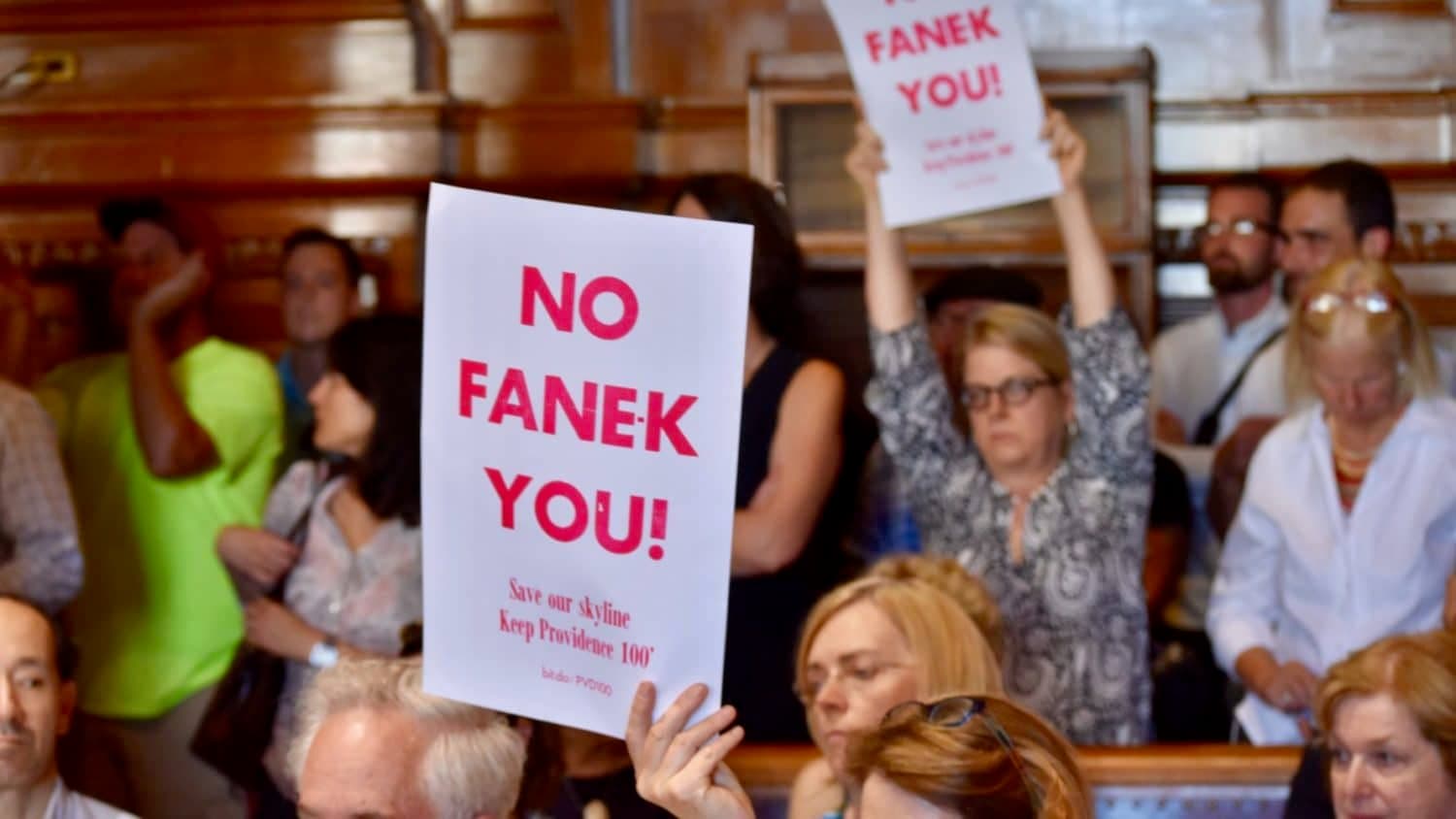
The Providence Journal really tips its hand about its anti democracy agenda with the three examples that it uses to make the case that the people of the state are an impediment to business. I will come back to all thre in more detail later. The examples the Providence Journal used are the Pawsox moving to Worcester, the Fane Tower proposed for the Providence River, and the proposed Clear River Energy Center fracked gas power plant for Burrillville. I have been active opposing all three big money deals. I have been to many hearings, testified repeatedly, and written about all three projects. This is just one of many essays I have written about economic development and community prosperity in Rhode Island from an ecological and justice perspective. It is clear the Providence Journal will always take the side of the rich against the community and has no respect for the right of communities to decide what is appropriate. Obviously democracy is just plain bad for business and the rich need to get their way no matter what.
The first thing the Providence Journal discusses in the editorial is the low unemployment rate, just about the national average, tempered by discussion of Rhode Island as the first place into a recession and the last place out. The First In, Last Out bemoaning always lays the blame on Rhode Island’s supposedly lousy business climate. Obviously the editorial board never reads the letters to the editor in their own paper or they would know that the whole business climate game is a scam perpetrated by the institutions funded by the Koch brothers as part of their campaign to destroy liberal democracy and pave the way for right wing autocratic rule. (See: here and here.) I have repeatedly asked the Providence Journal to produce statistically valid evidence that a business climate correlates with economic growth rates. They have produced zero, zilch. And the reason that they have not, nor anyone else, is that no such correlation exists in any statistically meaningful way. (See: here and here.)
Think about it. If a correlation between a state’s business climate ranking and its economic growth rate existed it would be headline news and tax cutting by legislatures would be totally uncontroversial as well as work better than it has in Kansas, Oklahoma, Wisconsin, and Arizona Every speech given by a politician would cite the study. But no study with this result is ever offered. And yet we are told to kowtow to this wisdom despite nothing to back it up except propaganda by the self interested. Consider the constant drum beat about the “weak” Rhode Island economy over the years being related to Rhode Island being business unfriendly, and then note the yearly staff reductions at DEM and the yearly effort to cut taxes for the rich and remove regulations. Rhode Island obeys corporate orders, slashes funding, cuts taxes, and yet very little changes so the corporados come back for more the next year, insatiably. Or take the case of North Dakota where the business climate rankings are always high but the entire state economy goes up and down with the fracking boom. It was #4 in the nation for business climate rankings the year its economy shrank by 9.6 percent.
For the last five years, year in year out, Rhode Island has averaged 70 percent of the US average growth rate, a growth rate pumped up by unsustainably exploiting all manner of resources, but in recent years primarily fracking. It is not the business climate that holds us back Maybe this is really what we are. Factors involved in calculating business climates are of very limited influence in determining growth rates. History, resource base, justice, environmental health, quality of life, and infrastructure are MUCH more important in determining a state’s growth rate, and provide a foundation not subject to rapid change. And no matter what we are told, history and natural resources are not really subject to the whims of the legislature, the business magazines, nor the criminal think tanks funded by the Koch family fortune except when the rich rape and pillage. Maybe we are evolving into a 21st Century Steady State economy and would make more progress if we did not keep following the regressive policies promoted by right wing billionaires. (See: here and here.)
No one is opening new mines in Rhode Island, we have no oil, limited coal (there once was a coal mine near Garden City), a dearth of agricultural land, and our fisheries are stressed enough. We do not have vast teeming migrations from agricultural regions ( the anti immigrant right wing misses the biggest possible source of economic growth with their racist hatred) and forests being industrialized causing our cities to swell, though we get plenty of refugees fleeing American financed wars and dictators. Other than wind and solar power, new natural resource industries are not coming here in any meaningful way. We are a small state, with a relatively small urban core, not a global megacity. Our agricultural hinterlands are already urbanized and suburbanized. We are never going to match the global average for growth led by places with very poor rural populations rapidly urbanizing, let alone the US average as long as it is inflated by fracking. But we are expected to for some reason even though we have none of the characteristics that truly are associated with rapid growth. We float up and down with the Wall St, global and national economies and only a true localization movement will break that spell. Maybe we are already doing okay given who we are and to push for more does more harm than good? But it seems to be too slow for the already rich who need more to steal.
Let us go back to the business climate.
(See: here and here.)
First of all every ranking uses different criteria, and almost all of them have biased formulas, but one of the things that many of them wish for is that we just have a level playing field, that we do not give sweet heart deals to businesses. So Providence Journal, you are not only ill informed, you are hypocrites, as you regularly call for tax breaks for the rich. And what about capitalism? What self respecting capitalist would even take a subsidy? Are they all rent seekers rather than entrepreneurs? If you believe in free enterprise the whole idea of tax breaks and subsidies is anathema. Or is that a convenient fiction until it is your turn for the goodies? If we are giving subsidies, lets give them to local small businesses instead of offering the whole candy store to a few big players,. You could fund 1000 businesses with the subsidy that goes to one big player. Think about it. Which is going to create more employment in communities that need it most? One big business getting massive subsidies hiring mostly people moving in from elsewhere, or 1000 small subsidies to local entrepreneurs in low income neighborhoods? (See: here and here.)
The idea of subsidizing the rich so they can create jobs is a big meme in America, and yet contradicts the philosophy of getting the government out of the economy. But what is worse is that there is no evidence that subsidizing the rich, especially for downtown real estate development, actually does any good except for the owners of downtown real estate. Everyone else loses. Even the World Bank and International Monetary Fund know funding the wealthy is no way to develop an economy. As economist Thomas Piketty noted, it creates greater inequality, and ultimately that is bad for the long term economy.
And while we are at it lets get real about the mixed economy. If we are to subsidize, to use our tax dollars to improve life in the community through business, which does more good, and which is a more appropriate use of the public’s money? Millions to rich people for downtown real estate, a proposition that increases inequality and drives up the cost of housing for the entire city, or millions shared among 1000 people building local businesses Why is one frowned upon by the elite and the other expected? The straight answer is that the mixed economy is okay as long as its rigged for the rich, but not okay if it helps low income communities. (See here, here and here.)
If one takes government spending out of the picture, if the government no longer built infrastructure or ran schools, did not buy emergency relief supplies, did not maintain a national, or a state, or a local park system, no longer spent vast sums on new and better ways to kill, the economy would be very different, and smaller. Can you imagine the Western United States without its huge, publicly financed and managed water management systems, subsidized grazing ranges, and land giveaways for mining? Los Angeles would be a small desert community with a better river. None of the clowns who claim to be for pure capitalism would ever let the military industrial complex go completely private and we do know how poorly private soldiers worked out in Iraq. We have a mixed economy, and truly honoring that would help our economic development much more than accepting the hypocritical line that abhors subsidies except for the wealthy.
Mike Stenhouse, of the Rhode Island Center for Freedom and Prosperity (ought to be named Rhode Island Center for the Protection of the Old boys Money and Power (RICPOMP) said on camera when debating me on State of the State in 2017 that facts and statistics do not matter, following the lead of the orange headed monster in the White House and his Koch family paymasters. Always amazing when a person who runs a prominent “think” tank, one totally bought and paid for by the super rich, is so bad at parroting the corporate line that he admits he regularly lies because only if he lies can the story he wants told dominate the news cycle. If the truth were told, folks would laugh at him, just like the folks at the United Nations did to President Toxic Dump. Anyway, Mike Stenhouse tells us we should have a truly capitalist system, no rules, few taxes, no welfare, no health care for the low income and elderly. Government should be nothing more than a police force and an army, as the poor need nothing, not safe housing, decent food, medical care, or good schools. Everything should be private. But killing the poor, blacks, and foreigners at home and abroad is just fine as long as it helps the oil companies because that is what pays his salary. In other words, subsidize the toys and games of the rich and allow them to kill, loot, pillage, and pollute at will if we want the rich to get rich faster while everyone else falls further behind. The only thing Mr Stenhouse and I agreed on was that subsidizing the PawSox stadium was a very poor idea.