


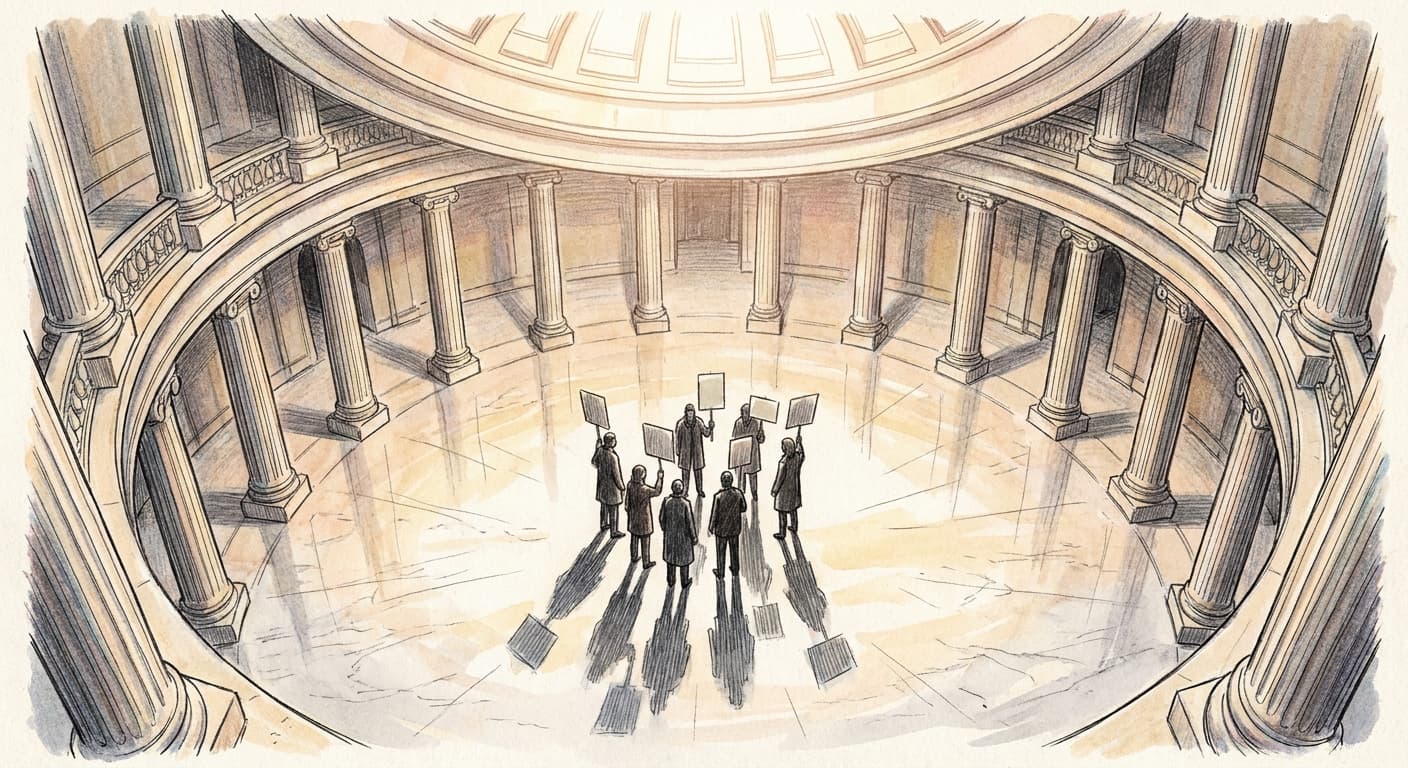
After his office barred homeless advocates from the State House rotunda during his 2025 State of the State address, Governor Daniel J. McKee has agreed to keep that space open for public demonstrations at every future annual speech, settling a federal lawsuit brought by the American Civil Liberties Union of Rhode Island. The ACLU of Rhode Island announced the settlement Wednesday, and it does something Rhode Island's most iconic protest space had, until now, been guaranteed only by a half-century-old court ruling: it puts the right in writing.
Under the terms filed with the U.S. District Court for Rhode Island, the parties agreed that "the Rotunda of the State House of Rhode Island shall remain open to the public, for purposes including but not limited to peaceful demonstrations … for not less than one hour before, during, and one hour after the holding of the annual State of the State address" — while acknowledging the state's right to "implement safety and security measures … to ensure safe ingress and egress" to the rotunda and other areas of the building. The state also agreed to pay $20,405 in legal fees, a reimbursement of the ACLU's costs and not damages to the protesters.
The case grew out of a single afternoon. On January 14, 2025, the now-dissolved Black Lives Matter RI PAC and the Rhode Island Homeless Advocacy Project planned a "People's State of the State" in the rotunda an hour before McKee addressed lawmakers, meaning to press the governor to declare a public health emergency for people living outside in the winter cold. When they arrived, they found stanchions, a sign declaring the rotunda "reserved for the State of the State through the Department of Administration" from 4:30 to 10 p.m., and Capitol Police and State Police at every entrance. Public records first reported by WPRI show the governor's office placed that hold at 4:39 p.m. — after the reservation's supposed 4:30 start, and as activists were already gathering. The rotunda stayed empty through the entire speech.
Local sponsorWorld-class website design at a small business priceCompany 50The ACLU sued in October 2025 on behalf of lead plaintiff Harrison Tuttle and others, alleging the reservation was a content-based pretext to silence critics and a violation of the First Amendment and the Fourteenth Amendment's Equal Protection Clause. The complaint said police shunted the demonstrators to the Bell Room, a recessed first-floor corner well away from the main entrance and elevators — though the chanting reportedly carried into the House chamber anyway. State officials, for their part, had described the rotunda as needed for "an overflow area" and "safe, alternative means of egress."
The legal footing for all of this is old. In 1973, Sister Mary Reilly and other members of the Sisters of Mercy were removed from the State House while praying and singing against Governor Philip Noel's proposed cuts to programs for the poor. The ACLU sued, and in 1974 U.S. District Court Judge Raymond J. Pettine ruled that "the State House rotunda is a public forum appropriate for the exercise of these First Amendment rights." That decision, ACLU of Rhode Island executive director Steven Brown noted, had defined the space for more than fifty years. "Since that time, the rotunda has served as the epicenter for Rhode Islanders to peacefully express their views to state leaders and the public," Brown said in a statement.
Rather than head to trial, the two sides worked out an interim deal in January 2026 that opened most of the rotunda and first floor for that month's address, cordoning off only a stretch leading to the House chamber and most of the second floor for security. The "People's State of the State" went off in the rotunda on January 13. The permanent settlement, cooperating attorney Lynette Labinger said, now commits the state "to ensuring that such public access will be preserved for all future State of the State addresses."
McKee's office cast the outcome as its own handiwork. "This settlement reflects the successful approach we put in place for the 2026 State of the State Address in January," spokesperson Laura Hart said, "ensuring that members of the public could access and use the rotunda while also maintaining a safe and secure environment for event attendees." The agreement contains no admission of wrongdoing.
What is settled is the calendar. Come January, when the governor next stands to address the General Assembly, the doors below him will be open — a right that, like a good sauce, took decades to reduce down to something durable.