


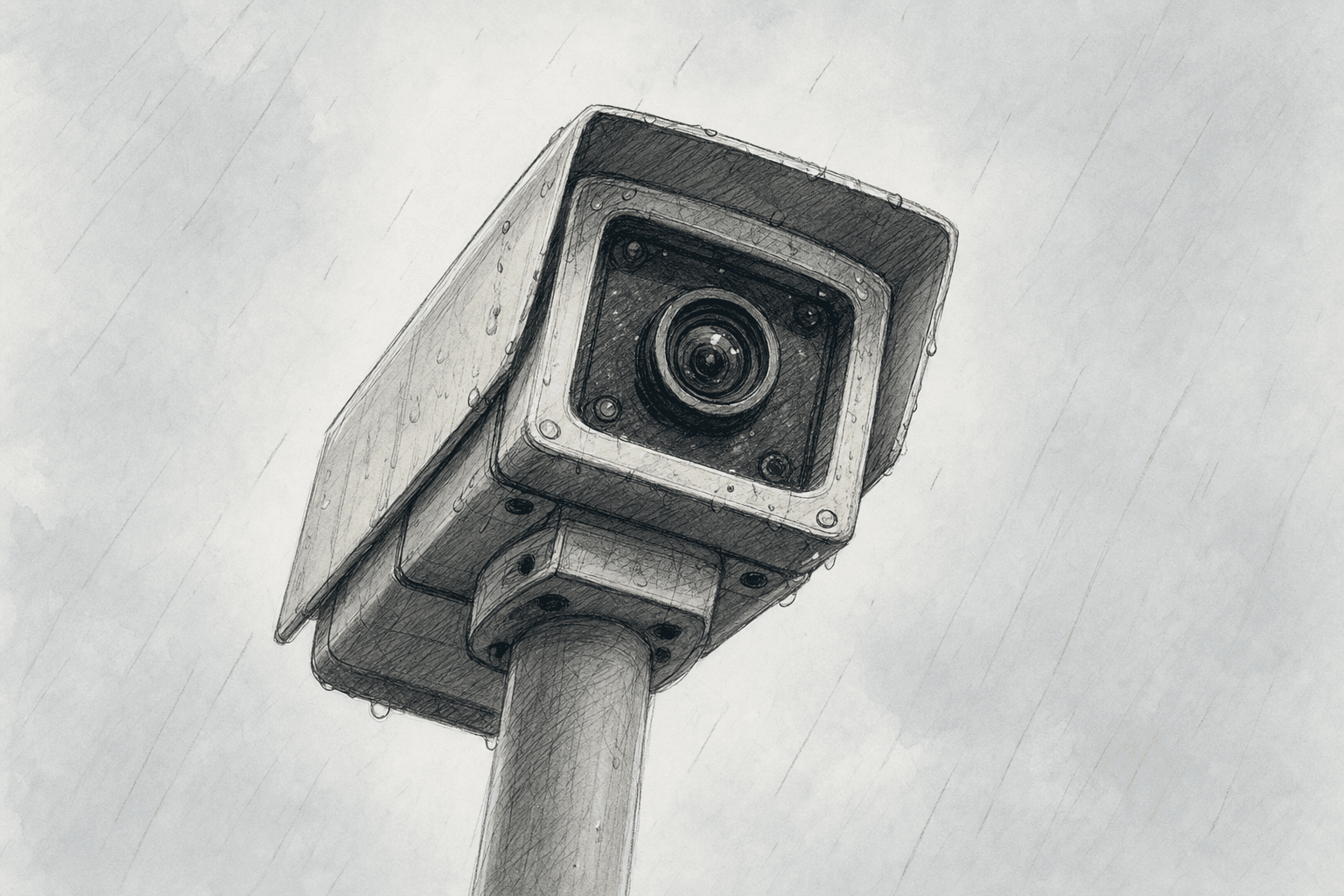
Rhode Island State Police are putting 39 automatic license plate readers on roads across the state under a three-year, $597,000 contract with Flock Safety, the Atlanta company whose cameras photograph every passing plate — along with the time, the location, the vehicle's color and body type — and dump the result into a searchable database that police can query by plate number or by description. The money comes from a federal COPS grant, the U.S. Justice Department's Community Oriented Policing Services program, which set aside $579,000 for the 39 units. The contract term begins once all of them are in the ground.
They will be joining a network that is already large. The ACLU of Rhode Island counts more than 290 Flock cameras statewide, municipal and state police combined — a system that started modestly in 2021 in Woonsocket, Cranston and Pawtucket, expanded to Providence on a free one-year trial in 2022, and has grown, town by town and council vote by council vote, into one of the densest plate-reader grids in New England. Cranston alone has 29 active cameras.
Here is the part that ought to interest anyone who drives to work: not one line of Rhode Island law governs how long that data is kept, who may search it, what justification a search requires, or which outside agencies may see the results. The safeguards that exist are policies — agency policies, vendor policies, contract terms — and policies can be rewritten by the people who wrote them.
Local sponsorAffordable photography lessons in Newport, Jamestown, or your town.E.L. Photo RICaptain Marc Alboum has said the State Police will not share Flock data with other states or with federal agencies. I take that as a statement of current intent, which is not the same thing as a statute. The complication is structural rather than personal: data-sharing settings ride on each individual agency's contract, and many Rhode Island departments already share with one another, so a plate search run by an officer in one city can return hits from cameras in a dozen others. A restriction that binds the State Police does not bind the department down the road that receives the same information.
Police leadership has made a straightforward case for the technology, and it deserves to be stated plainly before it is picked apart. On December 12, a camera on North Main Street in Providence photographed a grey rental car; the renter was Claudio Neves Valente, the suspect in the December 13 mass shooting at Brown University's Barus and Holley building. Kristy dosReis, Providence's chief public information officer for public safety, called that plate image "instrumental" to the investigation that followed. Cranston Police Chief Col. Michael Winquist has said his department has seized more than 100 stolen vehicles since 2021 and used the system in homicides, drive-by shootings and cases with few leads — 17 missing persons, 89 warrant arrests, 104 stolen vehicle arrests, 28 stolen property arrests. Officers there, he said, must enter a suspected offense, a case number and a reason before running a search.
The counterweight is not hypothetical. On July 6 the Georgia Bureau of Investigation announced the arrest of five former Albany Police Department officers after an internal audit found they had repeatedly accessed the Flock system and used retained plate data for non-law-enforcement purposes. Several California cities — Mountain View, Santa Cruz, San Francisco — found their data reachable by federal agencies, apparently contrary to that state's ALPR Privacy Act. An audit trail records misuse. It does not prevent it.
Which brings us to how these cameras got approved here. Late last year the State Police asked 22 municipalities to host the 39 new units; 19 of them said yes without ever taking the request up in public, according to the ACLU of Rhode Island. That is the sort of quiet procedural efficiency that tends to curdle once residents find out — and it has. Warren and Portsmouth turned the State Police down earlier this year, Portsmouth's council rescinding its earlier approval on July 13. Little Compton's council tabled its proposal on June 18 after receiving 12 letters of opposition and a 31-signature petition, and Police Chief Scott Raynes withdrew the request outright days later, writing that "we will no longer be pursuing the acquisition of the cameras." On July 27, the South Kingstown Town Council voted unanimously to cancel a contract it had approved in June 2025; the cameras are coming out.
The General Assembly had a chance at this and didn't take it. House Bill 5659, sponsored by Representative Matthew Dawson of East Providence — a former prosecutor of 21 years — would have required municipal police to get council approval after an advertised public hearing before installing readers. It was held for further study, which in Smith Hill dialect means the pot got taken off the burner and the water went cold. Vermont, Maine, New Hampshire and Massachusetts have all moved on ALPR rules. Rhode Island has not.
So the cameras go up on a federal grant, under agency policy, in towns that mostly never held a hearing, while four communities have now shown that a council vote can take them down. The next test is scheduled: the Rhode Island Turnpike and Bridge Authority takes up Bristol Police Chief Kevin Lynch's request for Flock cameras on the Mount Hope Bridge — the same cameras Portsmouth rejected — on August 17.