


Slowly at first, and now all at once, the true price of the war in Iran is coming into focus — and the number the White House gave Congress is not it.
An independent fiscal analysis published July 8 by Stephen Semler, a contributor to the Costs of War Project headquartered at Brown University's Watson Institute, places the direct military cost of the war's first 120 days at $103.3 billion — an average of $860 million per day from February 28 through June 27. That figure is more than triple the $30 billion that Office of Management and Budget Director Russell Vought told the House Appropriations Committee the war had cost, in testimony delivered in late June.
The gap between those two numbers is where the story lives.
Just one week before that testimony, on June 24, Vought signed a formal White House request for $88 billion in supplemental funding — a request that earmarked $72 billion specifically for the Iran war effort. The same official who put his signature on a $72 billion war line then told appropriators the war had cost $30 billion. The Pentagon and OMB have repeatedly refused to hand Congress itemized documentation supporting the lower figure, with Vought at one April hearing declining to estimate the cost at all on the grounds that the numbers "fluctuate on a day-in, day-out basis."
Semler's modeling, which draws on Congressional Budget Office wartime multipliers, military fleet tracking, and documented munitions use, itemizes the $103.3 billion this way: $28.5 billion for operations and mobilization, $46.7 billion for weapons expended, $20.3 billion for damaged or destroyed assets, $2.9 billion in munitions subsidies to Israel, and $4.8 billion for non-military federal agencies. His earlier report, published in May, had pegged the first 60 days at $71.8 billion — already well above the administration's running estimates of $25 billion in late April and $29 billion in mid-May.
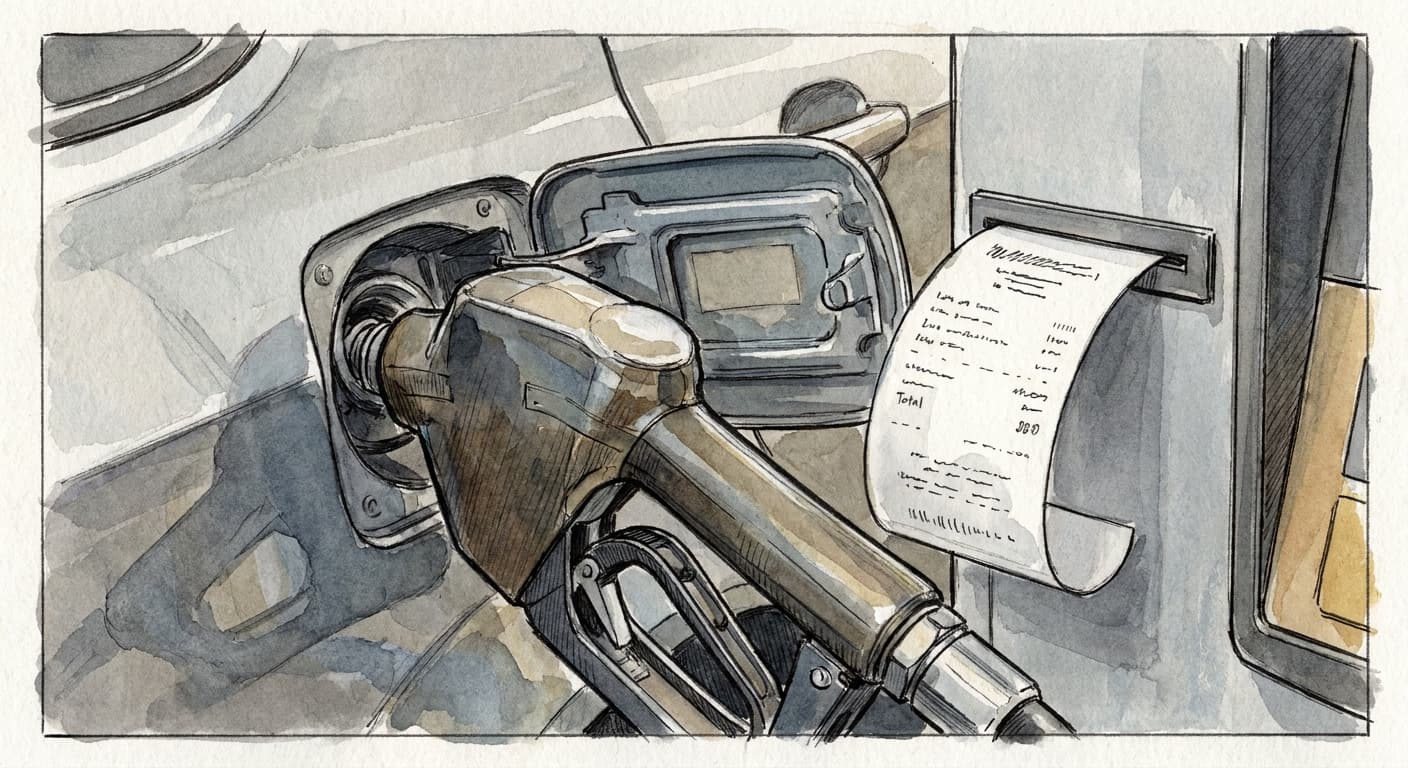
For Rhode Islanders, the abstraction of federal ledgers arrives at the pump. Average gas prices in the state climbed from a pre-war baseline of $2.88 per gallon to $4.48 at the height of the conflict, an extra $1.60 out of every gallon. That spike traces directly to Iran's March 4 closure of the Strait of Hormuz, which sent Brent crude past $120 a barrel and choked off a fifth of the world's oil supply.
A research brief released May 18 by Brown's Climate Solutions Lab and the Costs of War Project quantified the national version of that pain: higher gasoline and diesel prices caused by the war cost U.S. consumers more than $40 billion — over $300 per household — by mid-May alone.
While households absorbed that hit, the oil industry collected. Twenty-seven major oil and gas companies booked over $40 billion in profits in the first quarter of 2026, with Shell and BP earnings doubling from the prior quarter, and are on track for $234 billion in excess profits by year's end, according to figures compiled by Senators Sheldon Whitehouse of Rhode Island and Elizabeth Warren of Massachusetts.
Rhode Island's entire congressional delegation has fought the war on the floor and in the record. Senator Jack Reed, ranking member of the Senate Armed Services Committee, called it an unauthorized "war of choice" during the April 15 Senate debate over a War Powers Resolution, which Republicans blocked 52-47. When Reed criticized the administration's handling of the conflict in June, Trump attacked him on social media as a "liar" and "incompetent" and demanded his impeachment. Whitehouse was blunter about the war's origins: "I pray there is a plan beyond 'Wagging the Dog' over the Trump/Epstein files saga and a bungled economy."
On June 4, the House passed its own War Powers Resolution, 215-212, directing Trump to withdraw forces. Representatives Gabe Amo and Seth Magaziner both voted for it. The administration ignored both chambers, deploying narrow legal interpretations to claim hostilities had "terminated" while operations continued.
They have not terminated. The same day Semler published his 120-day figure, Trump declared the ceasefire "over" at the NATO summit in Ankara and ordered back-to-back nights of renewed airstrikes on Iran — guaranteeing the $860-million-a-day meter keeps running. The $88 billion supplemental remains locked in a legislative standoff, with the administration expected to seek still more through coming budget reconciliation bills.
Semler's polling analysis, drawn from 153 surveys across seven U.S. conflicts, found net support for the Iran war had fallen to negative 32% by June — a point below the worst reading Vietnam ever recorded.