


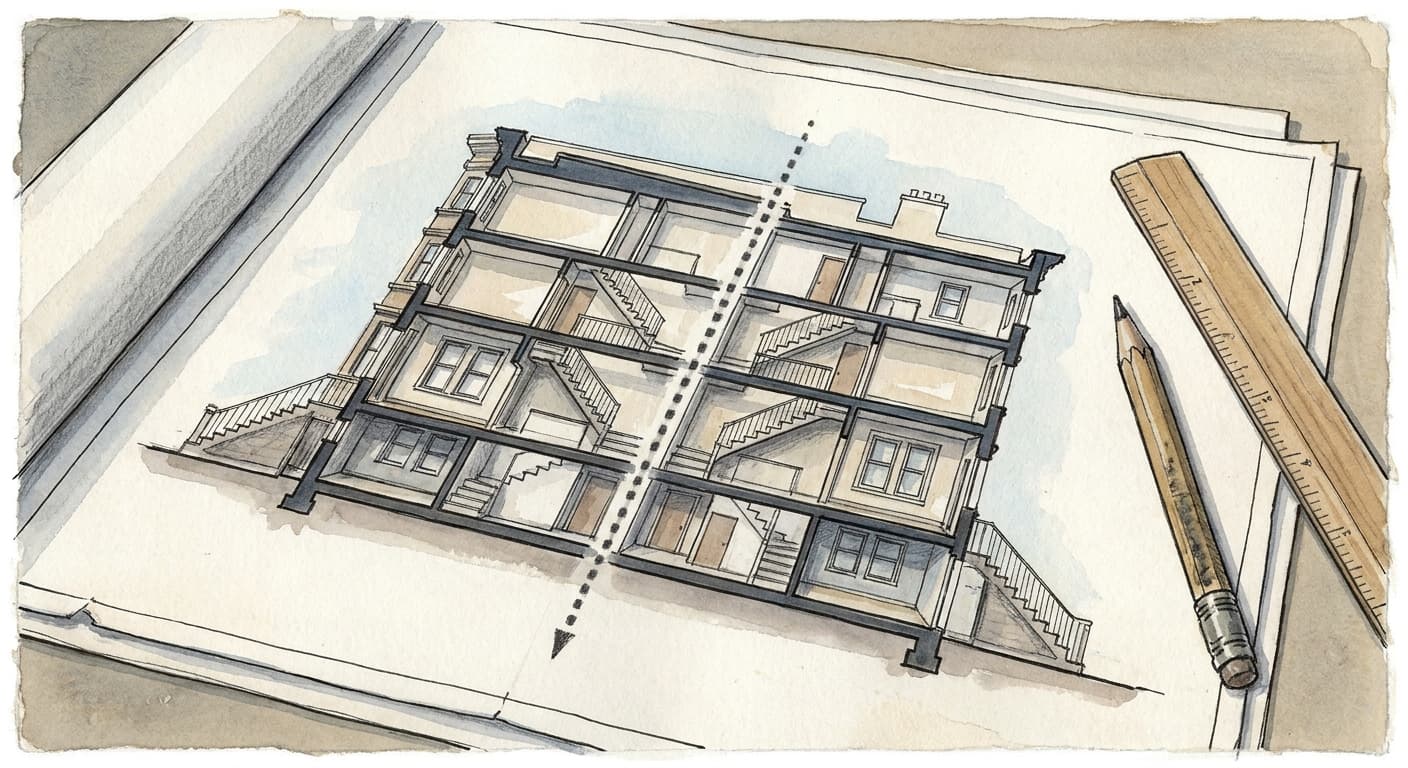
On August 11, the East Providence City Council will hold a public hearing on a zoning amendment that would let developers subdivide new multi-family buildings into individually owned, wall-to-wall townhouses — and build them not just in the city's residential neighborhoods, but along its commercial strips, too.
The proposal, filed with the city on July 15, would add a new section to East Providence's zoning code, Section 19-360.12, spelling out how "Attached Single-Family Dwellings" — the technical name for townhouses or rowhouses — can be built and subdivided. It is East Providence's local answer to a state law that took effect January 1, requiring every Rhode Island municipality to allow townhouses by right wherever duplexes or multi-family buildings are already permitted in residential zones. The East Providence version reaches further, proposing to allow the same townhouse subdivisions in commercial districts that already permit multi-family housing.
Why townhouses, and why now
Rhode Island's housing shortage has pushed rents and home prices to historic highs, and lawmakers have pointed to zoning as a root cause: 87% of the state's land has historically been zoned exclusively for single-family detached homes, according to legislative testimony behind the state's housing package. The townhouse mandate — House Bill 5798 Sub A and Senate Bill 1083 Sub A, sponsored by Rep. June Speakman and Sen. Meghan Kallman and signed by Gov. Dan McKee in June 2025 — was designed to open a middle path between renting an apartment and buying a detached house. Unlike a condo, where owners typically share a common land association, or a duplex, often owned outright by a landlord, a townhouse lets a buyer hold the deed to both their unit and the specific strip of land underneath it.
The East Providence draft lays out exactly how that would work on the ground. A developer would first have to show an "Original Lot" meets the city's existing dimensional standards for multi-family use. Only then could it be sliced along shared party walls into individual townhouse lots — lots that are allowed to be smaller, narrower and more tightly packed than the city's normal minimums, with side setbacks reduced to zero where units share a wall. To keep one owner's renovation from throwing the whole site out of compliance, the ordinance would require a deed restriction holding every unit owner "jointly and severally liable" for the zoning compliance of the original parcel, and it would require developers to set up a homeowners' association to manage shared driveways, parking, utilities and green space.
Who's behind the petition
The application was filed by attorney Dylan Conley, a land-use lawyer who spent several years as East Providence's Assistant City Solicitor before resigning in late 2024 and who later chaired the Subdivision & Land Development working group of the House Commission on Housing and Land Use. He filed it on behalf of two real estate investment firms, Jacavone Investment Corp. and Elevator Properties, Inc.
Jacavone Investment Corp. is led by Jesse Jacavone, whose affiliated company, Duo Development Corp., was awarded $1.03 million in state housing bonds on June 29 to build 15 owner-occupied townhouses in a converted industrial building in Woonsocket under the same legal framework — a project the Executive Office of Housing has held up as a model for the new law. Elevator Properties is led by Kyle Seyboth, a top-producing Rhode Island real estate broker who, along with his firm, is separately litigating a federal civil suit against title insurer CATIC over an "Agent Alert" the company issued against him in late 2024, alleging libel and interference with his business.
What the vote would — and wouldn't — do
Passing the ordinance would only establish the legal pathway for townhouse subdivisions citywide; any specific project, including whatever properties Jacavone Investment Corp. and Elevator Properties intend to develop, would still need to clear subdivision review and planning board approval. Organized resident opposition has not yet surfaced ahead of the hearing, though zero-setback construction and shared-driveway developments have drawn concerns elsewhere in the state over parking, traffic and emergency-vehicle access.
The City Council will take up the amendment at its August 11 public hearing, set for 6:30 p.m. at East Providence City Hall.