


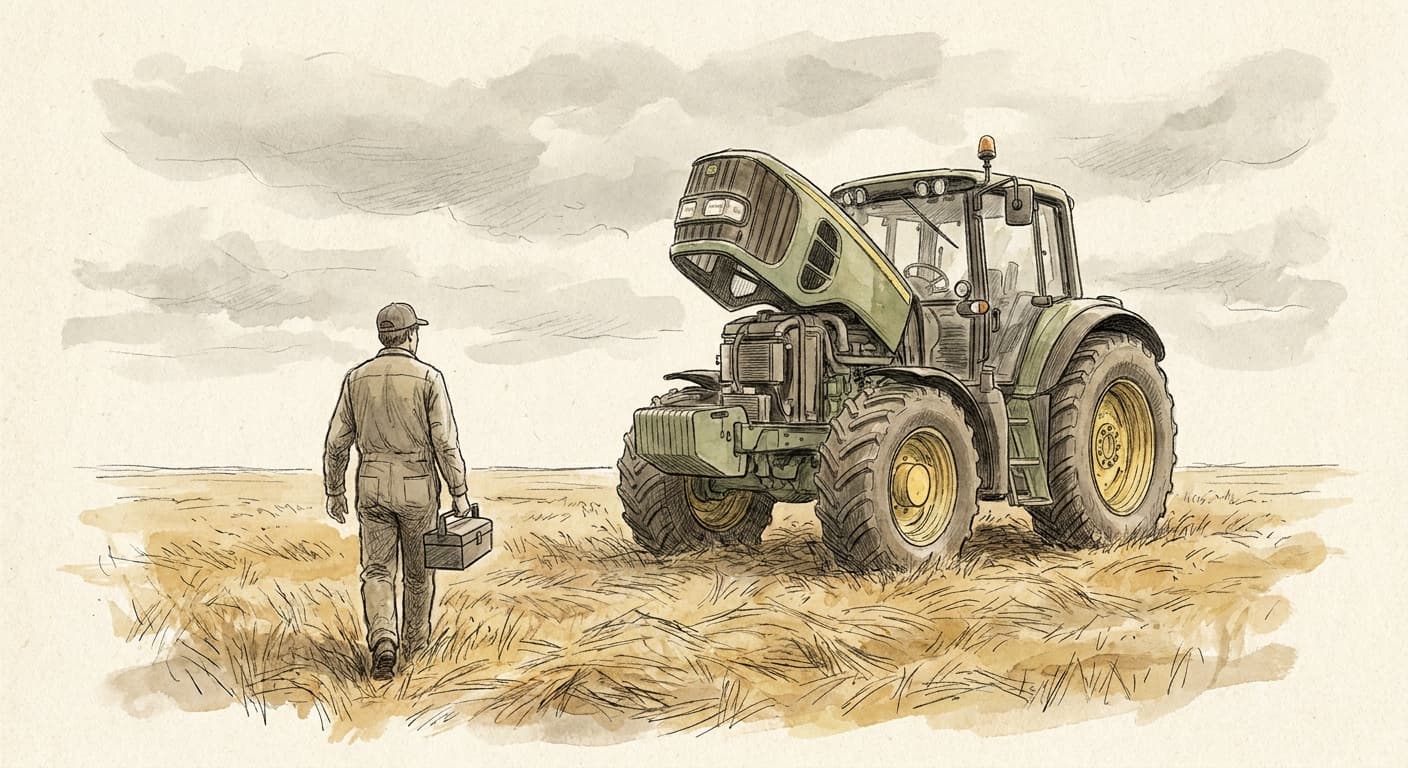
There are two ways to control a market. You can build a better product. Or you can build a better padlock.
For years, John Deere chose the padlock. The agricultural giant used proprietary software locks—specifically Electronic Control Units, or ECUs—to establish a captive, high-margin repair monopoly. If your tractor broke, you couldn’t just grab a wrench. You had to call an authorized dealer.
That monopoly is finally cracking. On July 8, the Federal Trade Commission and five states announced a sweeping, 10-year antitrust settlement forcing Deere to share its diagnostic software, repair tools like Service ADVISOR, and manuals with farmers and independent mechanics.
It’s a massive federal victory. But it shows in miniature how corporate control actually works—and why Rhode Island’s own legislative battle over the right to repair remains so deeply fractured.
I looked at the latest USDA census for our state today. Rhode Island is home to 1,054 farms. They average just 56 acres, making them the smallest in the country, but they sit on the nation’s most expensive farmland at $22,000 per acre.
Our farmers are squeezed to the penny. When a computerized tractor breaks down, the overhead is catastrophic.
Consider Dean Lees. In the winter of 2021 to 2022, the Lincoln family farmer was locked out of repairing his own tractor. With no local authorized agricultural dealers, fixing a software-bricked machine means thousands of dollars in towing fees and weeks of downtime. Lees' ordeal was the spark. It prompted Representative Mary Ann Shallcross Smith (D-Lincoln) to introduce Rhode Island's first agricultural right-to-repair bill.
Today, that fight continues. Shallcross Smith’s latest effort, the Agricultural Equipment Right to Repair Act (2026-H 7476), had a public hearing in March and currently sits pending before the House Corporations Committee.
The federal government is finally validating what farmers like Lees have said all along. April brought a $99 million antitrust class-action settlement in Illinois federal court, where Deere agreed to compensate farmers for inflated repair costs dating back to 2018. Then came this month’s FTC consent decree, mandating "fair and reasonable" access to component-pairing capabilities and fault code resets.
Why did Deere fight this so hard? The answer, as always, is the mechanism of profit.
Antitrust expert Matt Stoller detailed the math in a July 10 critique. Over 25 years, Deere consolidated its dealerships by more than 50 percent. They eliminated local competition. And it worked. With no independent mechanics allowed into the software ecosystem, authorized dealers could extract staggering rents: $150-plus per hour for labor, and 300 to 500 percent markups on parts.
The equipment lobby—led by the Association of Equipment Manufacturers—has long argued that opening up the software would allow farmers to bypass environmental controls. One could say that sounds responsible, but what it really does is provide cover for a monopoly. The EPA administrator formally refuted the industry's claim in August 2023, writing that returning machines to original specs does not facilitate emissions tampering.
So with federal momentum building, passing H7476 in Rhode Island should be simple, right?
Not exactly. The resistance isn’t just coming from corporate boardrooms in the Midwest. It’s coming from inside the state’s agricultural establishment.
The Rhode Island Farm Bureau actually opposes state-level right-to-repair bills. In 2024, RIFB President Henry B. Wright III submitted testimony arguing against a "fragmented system" of state laws. Instead, the bureau leadership backs voluntary Memorandums of Understanding (MOUs) signed in 2023 between major manufacturers and the national American Farm Bureau Federation.
Grassroots advocates at Repair.org and U.S. PIRG call those MOUs exactly what they are: toothless.
You have to read the fine print. A private-sector MOU offers no judicial oversight. It carries no real enforcement mechanism. Manufacturers can cancel it on 30 days’ notice. It is a public-relations tool designed to stave off binding laws.
Stoller warns that despite the FTC settlement, Deere’s parent corporation will simply hunt for new technical loopholes—like proprietary SpaceX Starlink integration or farm-data monetization—to satisfy Wall Street's demands. These problems are best confronted with law, details, and enforcement, not voluntary handshakes.
The FTC settlement is a hammer blow to a captive market. But here in Rhode Island, farmers hope to actually get the keys to their own tractors, A right-to-repair bill was introduced this year, but died in committee.
Until the padlock is legally broken, they'll just keep building a better one.