


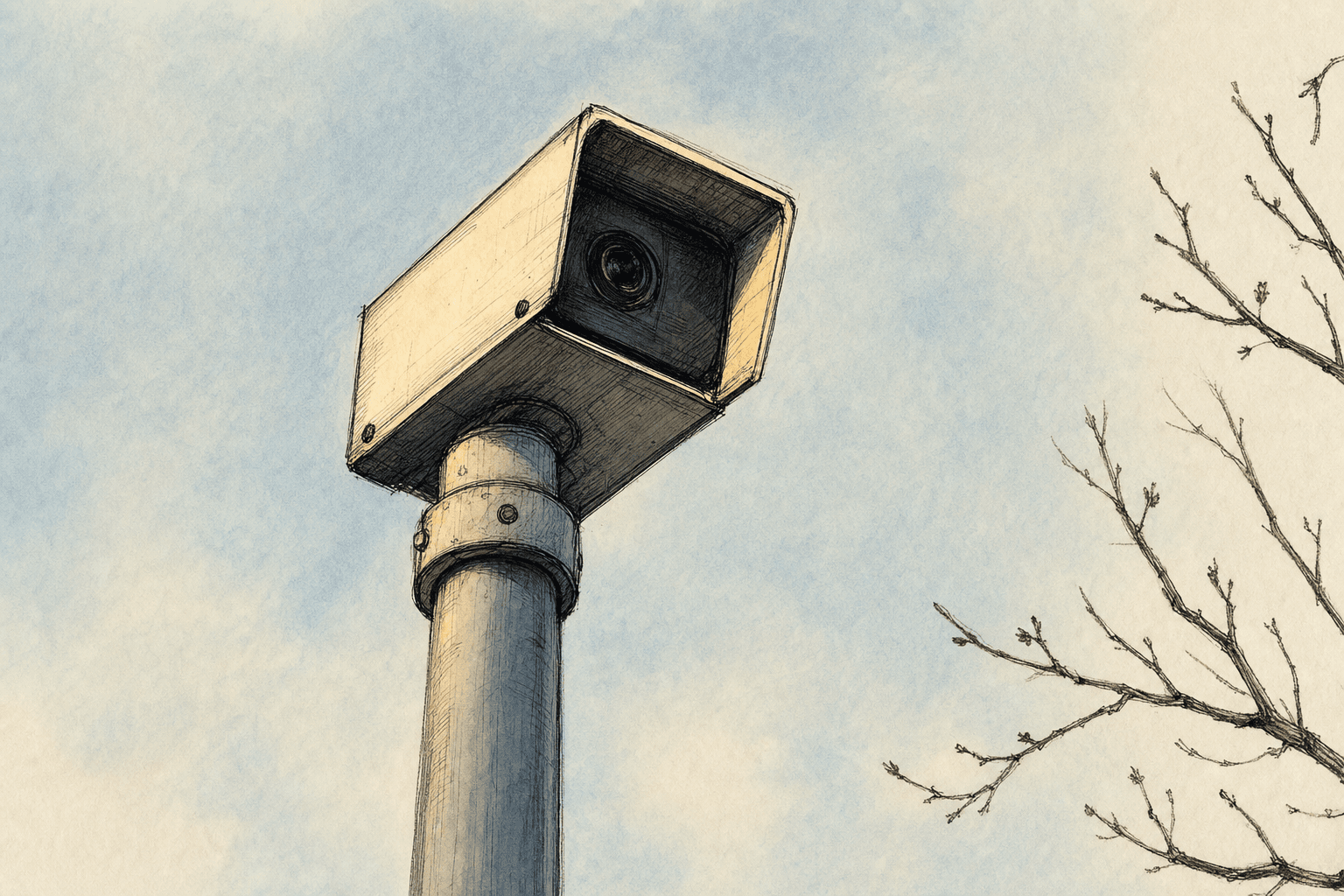
The Narragansett Town Council voted Monday to cancel the town's contract with Flock Safety, the company that operates license-plate-reading cameras at fixed points around town, effective immediately and before anyone in the room could say what the cancellation will cost.
The vote came at the council's August 3 meeting, according to the Narragansett Town Council's published meeting recording. The motion to terminate passed by voice vote, with the chair announcing that the motion passed 5-0. It was the last of roughly two hours of testimony, technical questioning of the police command staff, and public comment split between residents who called the cameras surveillance creep and residents who called them a useful investigative tool.
The practical effect for residents is that the three remaining cameras — a fourth was recently stolen — are to come out of service. Under the system as described at the meeting, every vehicle passing one of those cameras had its plate and a still image logged and held for 30 days.
Local sponsorAffordable photography lessons in Newport, Jamestown, or your town.E.L. Photo RIWhat the police department said the system does
The agenda item was co-sponsored by Town Council President Alexander Menzies and Town Council Member Jason Colonies, who each said they placed it on the agenda after months of resident concern.
The police chief asked the council not to act. He told the council he had spoken with Flock Safety late Friday and that the company wanted to send a representative, but needed at least two weeks' notice to appear before the council and the public. He said he supported the program when it was adopted and still does, describing it as a tool that has helped locate missing children, endangered adults and people with dementia, and has led to recovery of stolen vehicles and identification of suspects in shootings, robberies and carjackings.
He also pushed back on how the technology has been described publicly, saying criticism has been based on misinformation. It is a license-plate reader, he said: no facial recognition, no video recording, no image of the driver or passengers. He said courts around the country have held there is no expectation of privacy in a plate affixed to a vehicle for public view.
The department's four original cameras were placed on Boston Road by the North End Fire Station, on Point Judith Road by the South End Fire Station, on Woodruff Avenue by Citizens Bank, and near the Dillon Rotary. One has since been stolen, which the chief attributed to a national trend of opponents vandalizing, stealing or blocking the devices.
On cost, the chief said the first year was $12,600 and each additional year $12,000, paid entirely from forfeiture funds rather than tax dollars. Two installments had been paid, with a third due in January 2027.
The technical questions councilors asked
A captain who has administered the system since it began answered a long run of questions and, in the process, corrected several common assumptions.
Data is cleared from the cloud after 30 days, he said, and the department loses access at that point; the company tells the town the data is gone from its systems as well. That 30-day window is Flock Safety's default, he said, and the council could set a shorter retention period if it chose — some agencies use 10 or five days.
He said the department enters plates it is looking for into an agency-only list visible to Narragansett alone. The system allows agencies to share a "hot list" of stolen or suspect vehicles, but he said the department has not done that since the cameras went live in January 2025. He added that the department also has the option, with the click of a button, of sharing nothing with any outside agency at all.
The system does not return registration status or the registered owner's license status, he said. It runs plates through the National Crime Information Center, and the department gets a notification only for a stolen vehicle, a registered sex offender, or a nationwide entry such as a missing child. Patrol tablets can be used to look up a plate manually, he said, but the cruisers themselves do not read plates.
Asked for a concrete case, he described an April 2026 burglary on Boston Neck Road in which several hundred dollars in power tools were taken overnight. Non-Flock private surveillance showed a white sedan pulling into the driveway around 2 a.m. With no plate to work from, detectives searched the camera log for a white sedan in that area during that hour, got a plate, identified an out-of-town registered owner, interviewed him in West Warwick and obtained a confession. He said the image was downloaded and retained as evidence past the 30-day window.
Asked directly whether the town therefore holds a rolling 30-day record of every car passing those locations, he said yes, for vehicles that drive by the three operating cameras.
One councilor asked whether a resident could request deletion of their own plate record inside the 30-day window, or obtain it under public records law. The captain said the company would have to answer that and offered to look into it.
The privacy case
A policy associate at a statewide civil liberties organization testified. She said she is not a Narragansett resident and had sent the council a letter detailing the group's concerns, including a list of documented misuses nationally. Her central objection was the nationwide data-sharing model: handing plate data to another department without knowing how that department uses it, including whether it is passed to federal agencies for immigration enforcement.
She said legislation introduced at the General Assembly this year would have required municipal approval before cameras are installed, narrowed where they could be used, limited data sharing, and cut retention from 30 days to 21. The bill died. She said Maine and Connecticut use 21-day retention and New Hampshire holds the data for three minutes. Absent a state law, she said, the default is the company's 30 days, and her organization's recommendation is removal.
Asked who verifies that data is actually deleted on schedule, she said the public largely has to rely on the company's assurances — a point the council returned to later. The town manager, Jim Tierney, said a Rhode Island regulation bill had died in the House and that, in his view, its passage would have resolved some of these questions. He said he supports the program 100 percent as the department runs it, comparing the still images to bridge tolls and red-light cameras and noting that police have shared partial plate data across state lines for decades.
Residents split
A former council member who voted for the original program in September 2024 said the council at the time authorized a one-year pilot with a guarantee that continuation would come back for approval, and that this never happened. She said an additional two-year contract was issued instead, and urged the council to end the relationship, citing other communities that have switched their cameras off.
A resident who attended the neighboring town's council meeting on the same subject described the product as capturing a full "vehicle fingerprint" — make, model, color, body type, roof racks, bumper stickers, dents — and argued the town would be participating in a mass-surveillance network run by a private company. Another resident who works in technology urged the council to spend on officers, community policing and street lighting instead. A longtime resident said the tradeoff was not worth one recovered set of tools.
Not everyone agreed. One frequent commenter said the police department already runs a voluntary camera-registration program for residents with home security cameras, that personal data is already widely exposed, and that the good may outweigh the bad — suggesting the town continue another year. Another resident, Dr. Al Alba, laid out both sides and suggested putting the question to voters in November rather than deciding that night.
The vote, and the unanswered cost
Menzies said his concern was less the local department than the absence of state regulation and the sharing of data with agencies whose practices the town cannot verify, and that Narragansett's comparatively low crime rate made the necessity harder to justify. Colonies said he sees the benefit but understands the privacy objection, and initially framed his position as a pause.
That framing shifted when the contract term came up. Menzies said his understanding from the 2024 agenda materials was a one-year deal; the town manager said the contract carried an automatic renewal and that the current expiration is September 2027. The town manager said the contract was approved by the solicitor at the time and attached to the council agenda, and that it specifically stated the renewal period.
Colonies then moved to cancel effective immediately, and the motion was seconded. A councilor asked whether cancellation carries a penalty. Town Solicitor Tom Callahan said he was looking up the terms during the meeting and would need more time to be sure, but that the president's assessment appeared correct. Menzies had estimated the town would likely eat roughly $12,600 for the final contract year plus any additional fee.
The council was offered the option of continuing the item to the next meeting to get a firm number. Menzies said he had enough information to decide, asked for and got a consensus from colleagues, and moved to a vote to terminate "and for the town to face whatever penalties come from terminating the contract at this time." The motion passed by voice vote, announced as 5-0.
Residents who want the exact financial consequence will have to watch for the solicitor's review, which had not been completed when the vote was taken. The council's next regularly scheduled meeting is the venue for any follow-up; the council also voted separately Monday to schedule a September 21 public hearing on an unrelated zoning ordinance change. Full audio of the discussion is in the town's published recording of the August 3 meeting.