


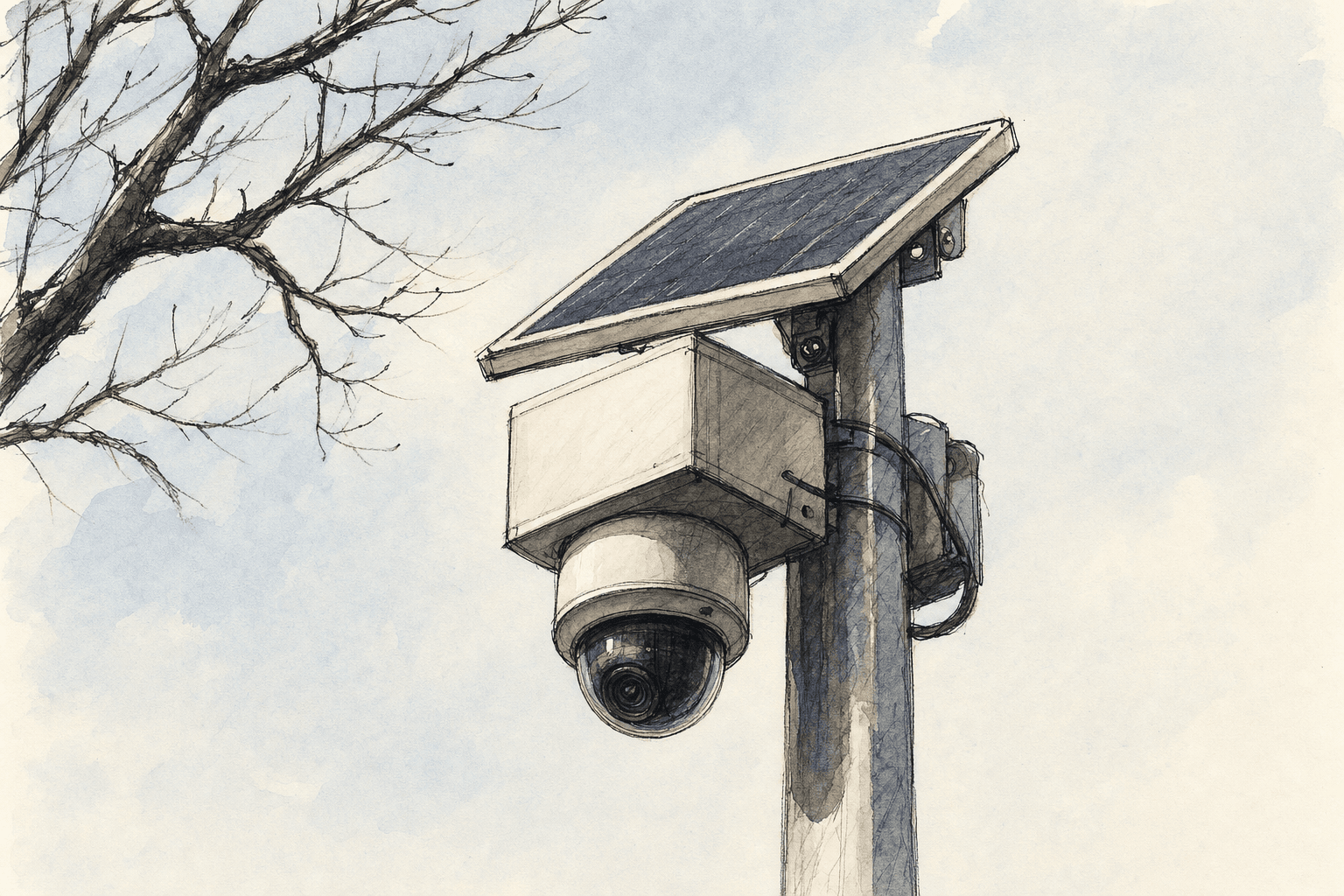
South Kingstown's Town Council voted 5-0 Monday night to terminate the town's contract with Flock Safety, the Atlanta surveillance company whose automated license plate readers — cameras that photograph every passing vehicle and log the plate, the time, the location, the color and the body style into a searchable database — have quietly proliferated across Rhode Island police departments since roughly 2021. The council did not merely cancel. It asked that the cameras come down as soon as possible.
Councilors said they had received hundreds of emails from residents raising the possibility of misuse and privacy infringement. "Just because the technology exists doesn't mean we should use it," Councilor Michael Marran said.
That is a sentence worth sitting with, because for five years the working assumption at municipal tables across this state has been precisely the opposite.
Local sponsorWorld-class website design and custom software at a small business price.Company 50The scale of what South Kingstown is walking away from is easy to underestimate. The ACLU of Rhode Island, which has been tracking deployments since 2021, counts at least 295 Flock cameras in Rhode Island, and says plainly on its Flock 101 page that the exact number cannot be pinned down because some departments will not supply detailed information. The organization's core complaint is not the cameras' existence but the vacuum around them: absent any state or local law, there is very little transparency about how the data is used, who may access it, or how long it is kept. Providence operates the largest deployment at 56 cameras, followed by Cranston with 27, East Providence with 19, Woonsocket with 15, Warwick with 10, and smaller clusters in Johnston, Smithfield and at Rhode Island College. Together, by that accounting, they scan more than 2.8 million vehicles a month in a state of roughly a million people.
The sharing is the part that tends to surprise people. Woonsocket's data flows to more than 400 other law enforcement agencies around the country; Providence shares with 39 departments, including the New York State Police and agencies as distant as Houston. A plate read on a Rhode Island street does not stay on a Rhode Island street.
Two grassroots tools have made that abstraction searchable for ordinary residents. DeFlock, launched in October 2024 by software engineer Will Freeman, maintains a crowdsourced map of reader locations built on open mapping data and has catalogued more than 107,000 cameras nationally. HaveIBeenFlocked.com lets people search police audit logs — 2.3 million license plates and tens of millions of individual search queries — that became public because multiple departments failed to properly redact them before releasing records under public records requests. Flock's response to both has been legal: a cease-and-desist to Freeman alleging trademark dilution, which the Electronic Frontier Foundation rejected on his behalf in February 2025 as an assault on protected speech, and threats aimed at the audit-log site, whose creator maintains he is aggregating information that was already public. How widely Rhode Islanders are using either tool is not something anyone has measured.
Police here defend the technology in consistent terms. "We're not tracking people," Cranston Police Col. Michael J. Winquist has said. "All it does is give us a lead." And the strongest version of the law enforcement argument arrived in December, when Providence police credited a Flock camera with helping locate the suspect in the Brown University shooting — investigators searched the network by vehicle description, which led them to a rental agreement and an identification. To be sure, that is a real outcome, obtained fast; the uncomfortable point for both sides is that the same dragnet that produced it was photographing everyone else's car too.
Rhode Island's legislature has twice been handed the chance to draw lines. H7749, introduced in 2024 by Warwick Rep. Joseph J. Solomon, would have restricted readers to identifying stolen vehicles, barred selling data to third parties and capped retention of non-investigative data at 30 days; the House Judiciary Committee held it for further study. This session, H8077 — sponsored by East Providence Rep. Matthew S. Dawson, a former prosecutor and the Judiciary Committee's second vice chair, with nine co-sponsors — was heard by the same committee on March 24.
Elsewhere, the ground is shifting. Portsmouth's council rescinded its earlier approval for Flock cameras on July 13. Tiverton's approval passed on a 4-4 vote with three members absent, subject to a termination clause and solicitor review. In federal court, a Fourth Amendment claim against Norfolk, Virginia's use of the system survived a motion to dismiss, and the ACLU filed an amicus brief in the Fourth Circuit in April arguing the technology hands government surveillance powers that overturn ordinary expectations of privacy.
Meanwhile, the police chiefs are not conceding. When former Pawtucket officer Noel Pichardo testified against H7749 in April 2024 — he says he raised internal concerns about privacy and abuse, was suspended without pay, lost a promotion and was ultimately forced out — the Rhode Island Police Chiefs' Association wrote to the committee calling his account inaccurate at best and, at worst, inflammatory and patently false. Pawtucket's chief, Tina Goncalves, told lawmakers Pichardo was trained on the system in 2021 but was not an authorized user. Those competing accounts remain unresolved.
Which leaves the question the General Assembly has now deferred twice. Rhode Islanders spent five years being enrolled in a national plate-tracking network nobody voted on, one camera at a time, the way a sauce thickens on a back burner — imperceptibly, until you lift the lid and find it will not pour. South Kingstown lifted the lid.