


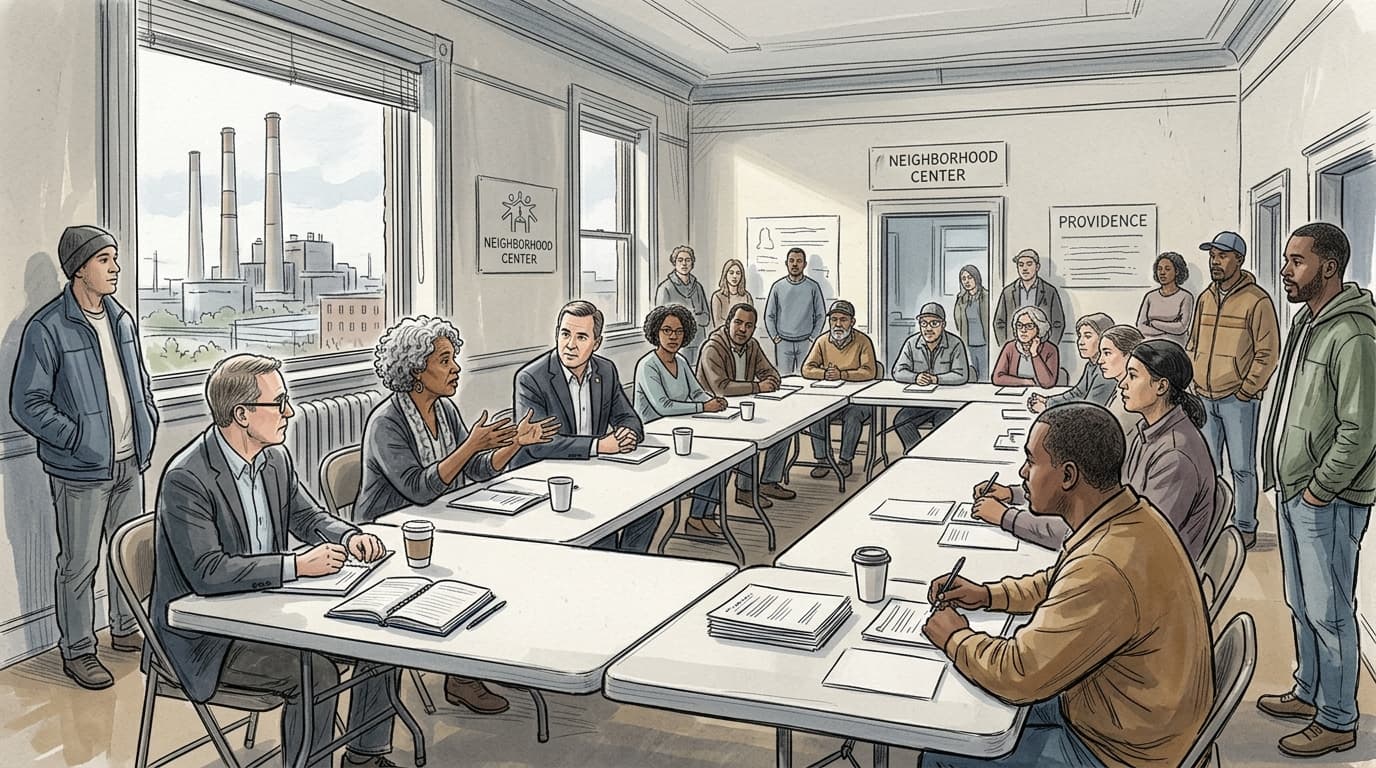
At the Elmwood Community Center on June 30, Mayor Brett P. Smiley stood beside Director of Sustainability Priscilla De La Cruz to launch something Providence hasn't done in seven years: rewrite the rulebook for how the city fights climate change in its own most polluted neighborhoods.
The event, according to the City of Providence, marked the kickoff of community engagement for a five-year update to the city's Climate Justice Plan — the first comprehensive revision since the plan was published in 2019. The city says the update will be based on "the most up-to-date science and input from Providence neighbors."
The location was not incidental. Elmwood sits among the neighborhoods the original plan singled out as "frontline communities" — South Providence, Washington Park, the West End and Wanskuck — areas that border industrial zones and, according to the plan, "have multiple sources of pollution and the highest levels of poverty, asthma, and lead poisoning in the state."
What made the original plan different
When Providence adopted its Climate Justice Plan in 2019 under then-Mayor Jorge Elorza, city sustainability officials described it as a national model — not because of the emissions targets it set, but because of who helped write it. A community-based Racial and Environmental Justice Committee, made up largely of residents of color from frontline neighborhoods, co-designed the plan alongside the Mayor's Office of Sustainability, according to city and outside reporting reviewed for this story. Community members committed roughly ten hours a month to the process and received a $1,300 honorarium for their time.
The resulting document set concrete, dated targets: 100% renewable electricity in municipal buildings by 2030, reduced childhood asthma emergency-room visit rates by 2035, and three resilience hubs in frontline neighborhoods by that same year, among others. Its equity rationale rested partly on a 2016 report from the American Council for an Energy-Efficient Economy, which found that low-income Providence households spent 9.5% of their income on energy — more than double the 4.7% spent by other households, putting the city fifth-highest nationally for low-income energy burden at the time.
The city's own budget documents have described the plan's collaborative model as "nationally recognized," though that characterization comes from Providence's own materials rather than an independent national ranking, and some reporting from 2019 and 2020 that called Providence "the only city in the country" with a climate justice plan predates similar efforts since launched in other cities.
Progress, and unanswered questions
Since 2019, the city has taken steps tied to the plan's goals: a 2021 ordinance directing the Department of Sustainability to adopt its targets, a Sustainability Commission with dedicated environmental-justice and youth seats, a Building Energy Reporting Ordinance, the Providence Community Electricity program, and, as of April 2026, the city's first green revolving fund — a $3 million pool intended to finance renewable energy and decarbonization projects.
But whether the same power-sharing model will govern the update is unclear. In February 2024, Providence Sustainability Commission Chair Julian Drix raised concerns, in remarks reported by independent journalist Steve Ahlquist, that industrial growth maps in the city's separate, state-mandated Comprehensive Plan could conflict with the Climate Justice Plan's environmental-justice priorities — some of the affected census tracts, he said, ranked among the most burdened in the country. The Comprehensive Plan was ultimately adopted in November 2024 with a sustainability chapter addressing frontline neighborhoods and was state-approved in January 2026, but it could not be confirmed how, or whether, Drix's specific concerns were resolved in the final text.
It also remains unclear whether the Racial and Environmental Justice Committee will be reconstituted in its original form for this update, who currently sits on it, or what the city's engagement calendar — surveys, meetings, deadlines — will look like going forward. The city maintains a dedicated webpage for the update, though its full contents were not accessible for this story.
De La Cruz, who has spent 14 years in environmental and climate justice advocacy in Rhode Island, including as a former Audubon Society government affairs director and Environment Council of Rhode Island president, has said her priority is "implementing the Climate Justice Plan and honoring its intentional framework that centers racial equity and meaningful community engagement," adding that the city is "committing to not leaving any of our frontline communities behind."
The update also lands amid a broader, unresolved state debate: an Environmental Justice Act sponsored by Sen. Dawn Euer has passed the Senate but stalled in the House, and a separate "Green Justice Zone Act" pending at the State House would create a special protected district in Providence with its own oversight board. Both bills trace back in part to community anger over industrial expansion, including a controversial scrap yard on Allens Avenue in Washington Park.
For now, the clearest next step for residents is the one the city has already taken: showing up. The Elmwood kickoff was billed as the start of a public engagement process, though the specifics of how and when Providence residents can formally submit input have yet to be fully spelled out.