


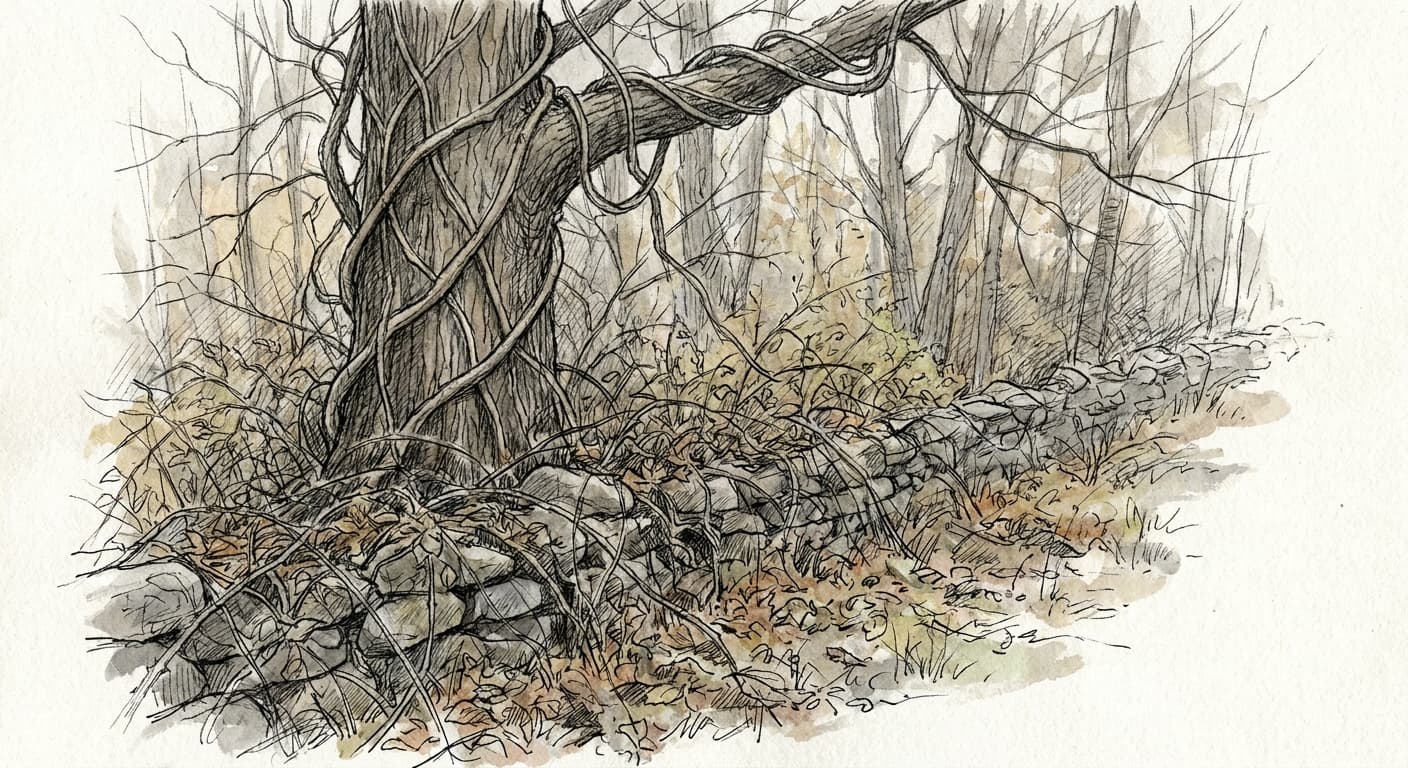
Little Compton resident and land steward Luke Driver told the Town Council that invasive vines are slowly killing trees across the town's roadsides and preserved open space, and asked the council to publicly back a volunteer-led removal effort before the damage becomes irreversible. Driver made the presentation at the council's July 9 meeting, according to the Little Compton Town Council's published meeting recording.
Driver, who said he has worked along the town's roadside edges and stone walls for close to 50 years, told the council that multiflora rose, oriental bittersweet and wild grapevine have overrun roughly 5,000 acres of preserved public land in town, about one-third of Little Compton's total land area. He said the vines have also spread onto private property along nearly every road.
Using photographs taken at 30 locations along West Main Road, Driver showed what he described as thickets 12 to 15 feet high and 30 feet deep that many residents mistake for natural hedgerows. He said the growth blocks sunlight to the forest floor, killing native plants and the insects and songbirds that depend on them. Bittersweet vines, he said, wrap around tree trunks and squeeze the bark and the cambium layer, the thin tissue beneath the bark that carries sap, eventually cutting off the tree's water and food supply and killing it.
Local sponsorWorld-class website design at a small business priceCompany 50Driver illustrated the problem with a tree on West Main Road that he estimated is roughly 150 years old, with a trunk about five feet around and a 90-foot canopy. He said he cleared a 12-to-15-foot-high tangle of vines from around the tree using a mini excavator and uncovered a goldenrod meadow beneath it, though he said the meadow is already becoming reinfested with young multiflora rose. In a separate example, he said it took him four weeks to clear an acre of overgrowth and expose a stone wall that had been hidden for roughly 60 years.
Driver said his preferred method is digging out root systems by hand rather than using herbicides, because even a small fragment of root left behind will regrow. He said he uses a smartphone application called iNaturalist to log and verify invasive plant sightings, and he urged residents to check their own property for large bittersweet vines and cut them at the base.
Driver pointed to the Nature Conservancy's response to a separate infestation elsewhere in Rhode Island, where he said a spongy moth outbreak killed enough forest that the organization had to hire a logging company with heavy mulching equipment to clear dead trees and start over. He argued that outcome, and its cost, is what awaits Little Compton's preserved land if the vine problem is not addressed soon.
A longtime Little Compton resident who said he has served on a town land trust for 16 years spoke in support of Driver's effort, telling the council that Driver has knowledge and skill but no budget. He recommended the council simply acknowledge the problem and lend its support so Driver can coordinate with the town's conservation and preservation groups, its tree committee and the Nature Conservancy. He said council backing would make it easier for Driver to work with those organizations. Driver closed his presentation by offering eight hours of his own excavation equipment and time to clear vines from an actively farmed field of the town's choosing.
The council did not take a vote on the presentation, treating it instead as a discussion item. Council members indicated that if there is interest in supporting a specific course of action, a motion could be brought forward at a future meeting. No date was set for that follow-up discussion during the July 9 meeting.