


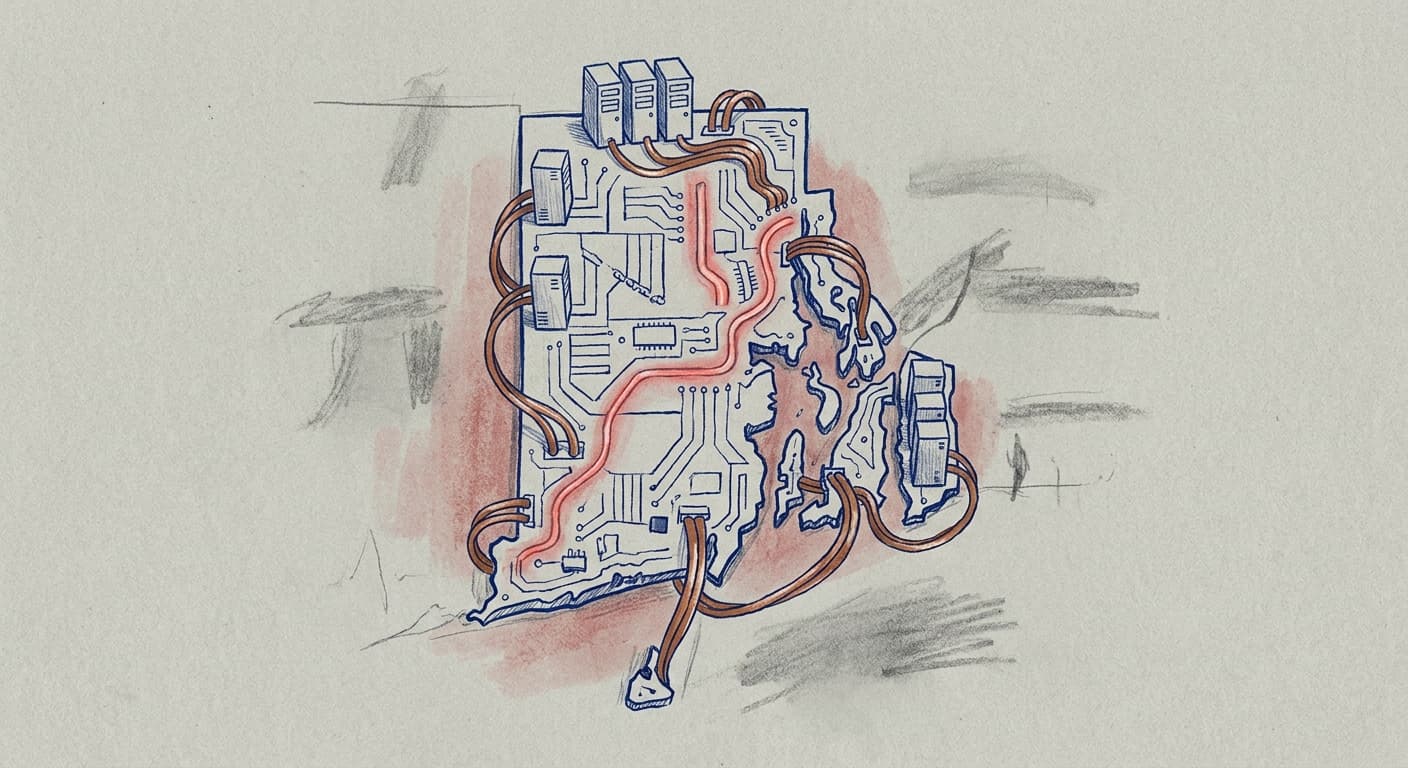
New York’s new one-year pause on state permits for the largest data centers has sharpened the choice facing Rhode Island, where lawmakers have considered both a 30-year tax incentive and requirements that large operators pay for grid upgrades as electricity demand from artificial intelligence accelerates.
New York Gov. Kathy Hochul signed an executive order on Jul. 14th pausing state environmental permits for data center projects of at least 50 megawatts while the state develops standards addressing energy, water and air-quality effects.
Rhode Island has taken a less settled approach. One Senate bill, sponsored by Sen. Louis DiPalma, would establish property, tangible, sales and use tax exemptions for qualified data centers, including a 30-year sales and use tax exemption intended to attract development.
Local sponsorWorld-class website design at a small business priceCompany 50A second measure would require certain data centers with large electricity needs to fund the infrastructure improvements necessary to supply that power. The two proposals are not inherently incompatible: One addresses incentives, while the other assigns responsibility for some of the costs created by new demand.
The disagreement centers partly on whether Rhode Island should subsidize an industry whose facilities can consume enormous amounts of electricity while supporting fewer permanent jobs than their construction activity might suggest.
“I think it would be insane to give a tax break to a lucrative project that would drive up our electricity rates even further,” Sen. Sam Bell, a Providence Democrat, told ecoRI News.
The issue is no longer abstract. A proposal first reported by ecoRI News this spring would place a data center on several hundred acres of woodland behind Fidelity Investments’ corporate office park in Smithfield. Revity Energy Vice President Ryan Palumbo and property owner John Branca appeared before the Smithfield Town Council in connection with the project.
Power availability has become a decisive constraint on the industry’s expansion. The International Energy Agency projects that global data center electricity use will rise from 415 terawatt-hours in 2024 to about 945 terawatt-hours in 2030, an annual growth rate of roughly 15%.
That expansion is distributed unevenly. A Pew Research Center analysis found 106 planned data centers and 397 existing facilities in the Northeast, equal to a 26% increase, while the South had 754 planned facilities and 1,209 existing ones, representing a 62% increase.
Rhode Island enters that competition with costly electricity and heavy dependence on natural gas. NuWatt Energy reported that rates reached $0.29 per kilowatt-hour this year, an increase of approximately 44% since 2020, and that natural gas accounts for about 90% of the state’s electricity generation.
The employment case is more complicated than the large construction totals attached to some projects. A Brookings Institution analysis of roughly 770 facilities found that counties receiving their first large data center recorded a 4% to 5% increase in total private employment over five to six years, including an 11% increase in construction employment and a 22% increase in information-sector employment.
At a typical county with 98,000 workers, Brookings estimated that impact at approximately 2,000 to 4,000 additional jobs after six years, depending on the type of facility. Individual hyperscale projects, however, can employ thousands during construction and only dozens or hundreds once operating.
Rhode Island’s two Senate measures received the same immediate result. The Senate committee considering S2346 and S2776 recommended on Mar. 10th that each be held for further study.