


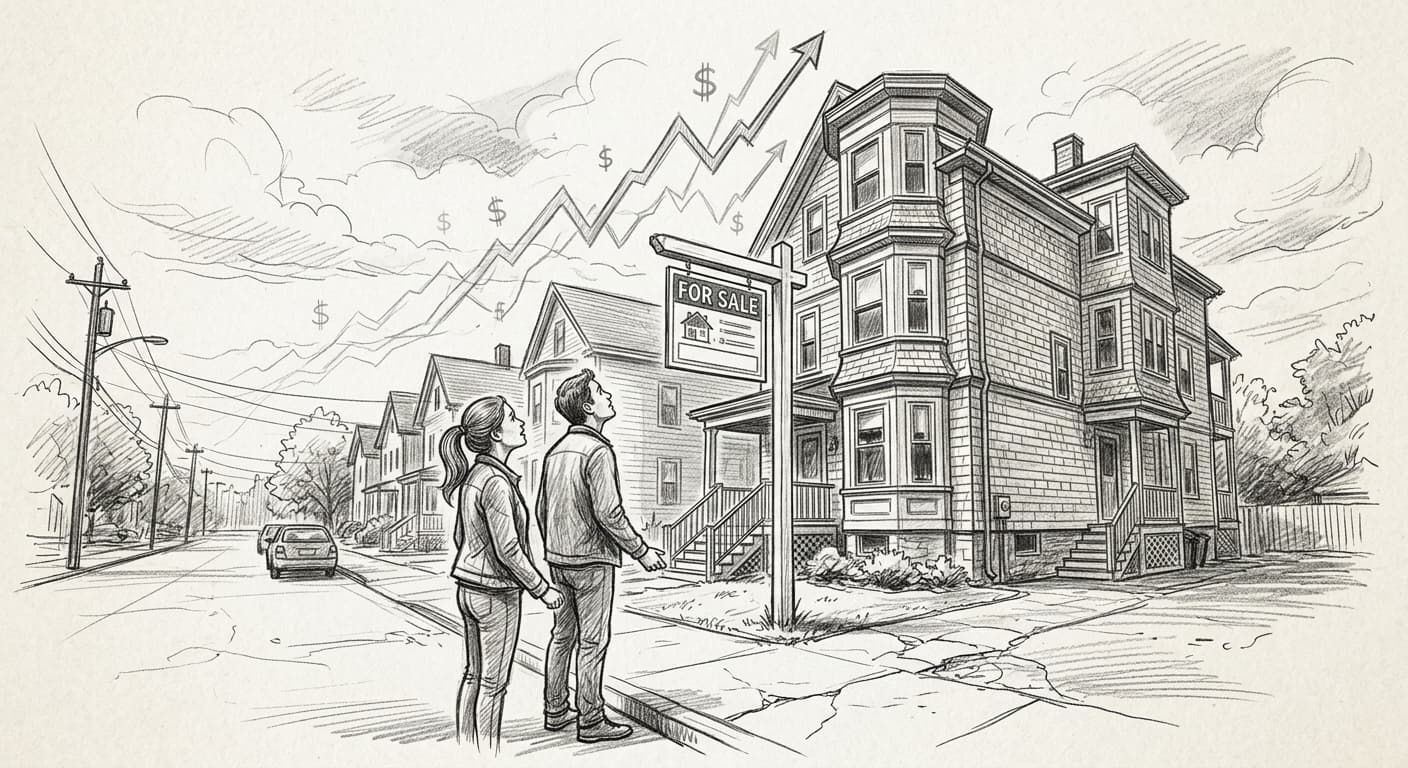
In 2025, for the first time on record, Rhode Island's median renter could not afford an average two-bedroom apartment anywhere in the state — not in Providence, not in Woonsocket, not anywhere. That renter earns $48,434 a year, according to HousingWorks RI's 2025 Housing Fact Book. Affording that average two-bedroom would take an income of more than $60,000.
That single fact, tracked for years by HousingWorks RI — a housing policy research group based at Roger Williams University — is now backed by fresh national data showing Rhode Island's squeeze is part of a much bigger, and newly documented, national pattern.
A Pew Research Center analysis published June 24 found that the gap between U.S. home prices and the incomes of under-40 households is the widest it has been in decades. Nationally, the inflation-adjusted median home value rose 30% between 2019 and 2024 — from $269,600 to $350,000 — while the inflation-adjusted median income of households headed by someone under 40 rose just 9%, from $92,700 to $100,900. The result: the ratio of home price to income for young households climbed from 2.9 to 3.5, a level not seen since the mid-2000s housing bubble, when it peaked at 3.6 in 2006.
For Rhode Islanders, the national headline is less a revelation than a confirmation. HousingWorks RI's own tracking shows that since 2018, wages statewide have grown by less than 30 percent while housing costs have increased by more than 60 percent — a gap advocates say has outpaced the national trend.
The math behind the squeeze
The numbers pile up quickly. HousingWorks RI's 2024 Housing Fact Book found no municipality in Rhode Island where a median homeowner income of $107,452 could affordably buy a home. A separate calculation cited by the Brown Daily Herald found that affordably renting or buying in Rhode Island requires an hourly wage of $40.52 or $69.08, respectively — well above the $33.20 hourly wage a national report found necessary to rent a modest home in the state.
Nationally, Pew's researchers found the squeeze isn't confined to expensive coastal cities: in 142 of 160 metro areas analyzed, median home values grew faster than young households' median income between 2019 and 2024. The share of metro areas classified as affordable for under-40 households fell from 59% to 39% over that span. Beyond the monthly mortgage payment, the down payment itself has become a barrier of its own — a 2024 Federal Reserve survey found 70% of renters under 40 said they rent rather than own because they cannot afford a down payment.
What the state is doing about it
Rhode Island officials have not been quiet on the issue. Governor Dan McKee and Secretary of Housing Deborah Goddard released Housing 2030, the state's first comprehensive housing plan since 2006, setting a goal of permitting 15,000 new homes by 2030, including 1,000 new homeownership units. Voters approved a $120 million housing bond in November 2024, the largest in state history.
More recently, General Treasurer James Diossa launched RI AnchorHome, a pilot program committing $60 million in state deposits to help first-time homebuyers secure 30-year mortgages at a starting interest rate of 3.99%, without private mortgage insurance, plus assistance for down payments and closing costs. "While this is not a solution to the housing crisis, I firmly believe it is a step in the right direction," Diossa said. RIHousing, the state's quasi-public housing finance agency, also runs a Statewide Down Payment Assistance Program that has helped more than 1,600 families become first-time homebuyers using $30 million in federal pandemic relief funds, along with FirstGenHomeRI, which offers $25,000 toward down payment or closing costs for first-generation homebuyers in several core cities.
Loophole or bottleneck? The zoning fight underneath it all
Brenda Clement, executive director of HousingWorks RI, argues that state-level funding and programs can only go so far while local governments retain control over what actually gets built. "What you build, where you build, and how you build are all at the local level," Clement said, pointing to towns including Johnston and Westerly that she says are actively fighting denser housing projects.
State data underscores the structural challenge: 87% of Rhode Island is zoned for single-family homes by right, according to the state Department of Housing, with only 20% zoned for two-family homes by right. The General Assembly passed a package of zoning-reform bills in 2025, including creation of a housing land bank and new mixed-use zoning mandates for municipalities, aimed at chipping away at those restrictions.
Not everyone agrees more subsidies or supply mandates are the answer. At a congressional hearing, Edward Pinto of the American Enterprise Institute, a conservative-leaning think tank, argued for unlocking existing housing stock through capital-gains tax changes rather than new subsidies, describing the housing supply problem as "an irresistible force meeting an immovable object." Ross Marchand of the Taxpayers Protection Alliance, a fiscal watchdog group, raised a different concern about a related federal push to restrict institutional investors from buying single-family homes, warning it could backfire: "It chills investment, and we need more investment in housing stock, not less."
The federal wrinkle
Congress passed the 21st Century ROAD to Housing Act by wide bipartisan margins in June — the Senate 85-5, the House 358-32 — a bill described as the most significant federal housing legislation in nearly two decades. Sen. Jack Reed, D-R.I., backed the measure. But President Trump abruptly canceled a planned signing ceremony, saying he would withhold action until Congress passes a separate bill. As of the most recent reporting, House Speaker Mike Johnson said the bill becomes law regardless if Trump doesn't act within the constitutional 10-day window — though the bill's final status could not be independently confirmed as of this writing.
For young Rhode Islanders weighing whether homeownership is within reach, the state's answer so far has been a stack of new programs layered atop an old, unresolved fight over local zoning control. Whether that combination — plus whatever comes out of Washington — actually narrows the gap HousingWorks RI has been documenting for years remains, for now, an open question.