


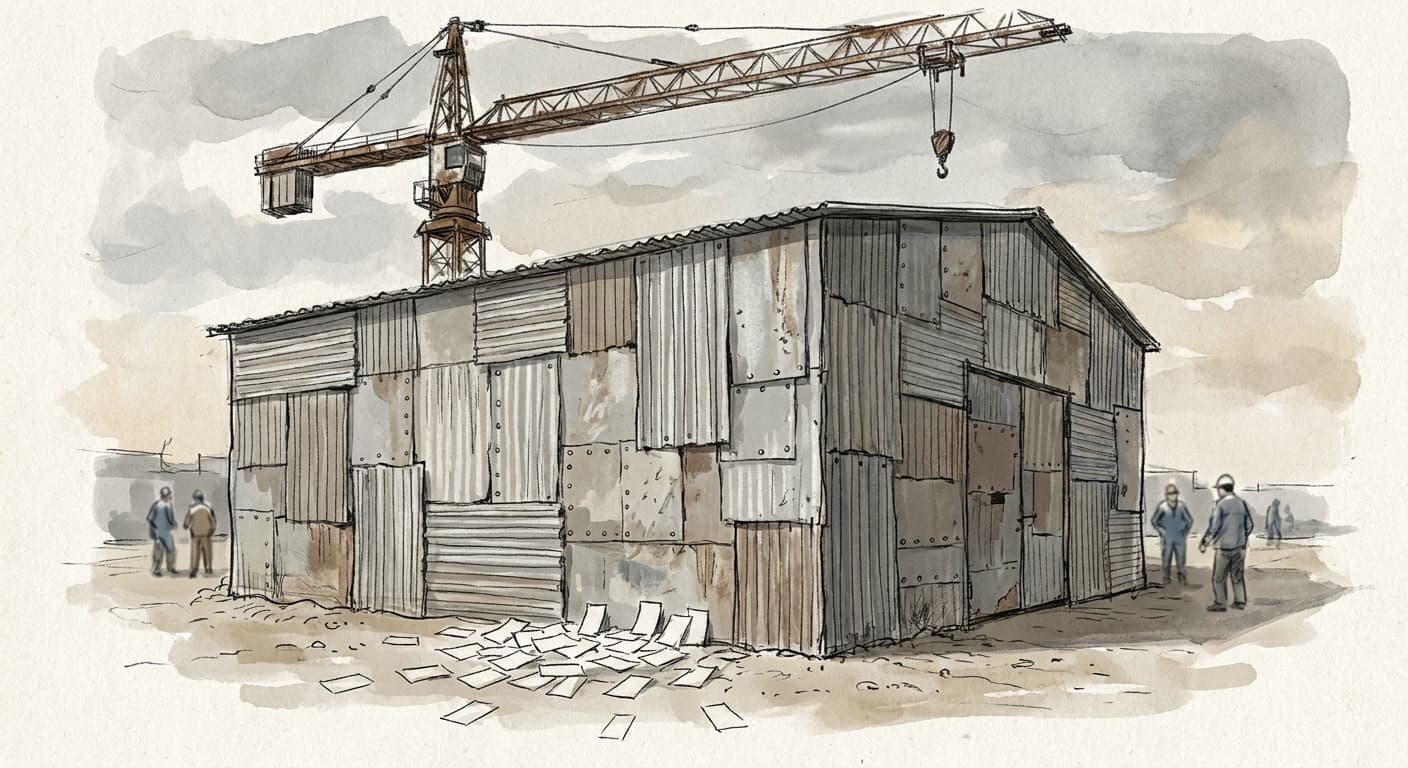
The Warwick City Council's Finance Committee voted 6-2 on July 6 to approve $197,000 in previously undisclosed spending on a police department warehouse project, after members learned the money had already been spent — some of it more than a year earlier — without council authorization.
According to the Warwick Town Council's published meeting recording, Councilman and Warwick Police Department representative Robert Hart told the committee the department was seeking to "correct" its original spending authority request for the warehouse project, which is funded through ARPA grant money. Hart said the original request had omitted a $197,000 contingency amount that covered 14 separate change orders — including repaving a parking lot, adding a fire-code partition wall, installing a "bump out" to accommodate equipment, and other items such as duct heaters, grinder pumps, stainless steel roof fasteners, and surge protectors.
Council members said the trouble was not simply that a contingency line had been left out of the paperwork. It was that the underlying work had already been approved and completed — in some cases as far back as July 2025, a year before the council was asked to sign off. One change order, item eight, a roughly $54,000 to $55,000 "bump out" needed to fit a fireproof partition wall around a mobile command vehicle, was dated December 18, 2025, meaning the city had committed to that expense roughly seven months before council approval.
Local sponsorWorld-class website design at a small business priceCompany 50Hart acknowledged the sequence directly when asked whether this was how such requests normally proceed. "As you can tell, no," he said, adding that the project was complete and the city now needed to pay outstanding bills. He said part of the funding was grant-contingent and had to be accounted for or the city risked losing it, calling the situation something that "got lost in the shuffle."
Council members also raised concerns about the documents themselves. Several change orders in the packet, including one labeled change proposal number three for the parking lot repaving and another labeled change order number one, were missing the contractor's signature; Hart said he did not know why, noting he had inherited the packet as provided and had not served as clerk of the works on the project. A council member pressed on whether an unsigned change order was legally binding; Hart said he was not an attorney but noted the city had already accepted and paid for the work through separate certified payment documents, suggesting a contractor could still hold the city to the price even without a countersignature.
Asked who was responsible for designing the building — naming the architect and the construction firm involved — Hart said he was not aware whether either had errors-and-omissions insurance, coverage architects and engineers are generally required to carry. He later said he did not believe any of the omitted items rose to the level of an insurable error.
One council member questioned why professionals designing and building the structure would fail to anticipate basic items like paving, door sweeps, or roof fasteners, comparing it to a contractor telling a homeowner mid-project that nails, a dumpster, or ice-and-water shielding had been left out of a roof estimate. Hart said some items were true change orders while others were "ad alternates" added later once the city learned how much grant money was actually available, and said he understood the frustration but that the project was now finished and bills needed to be paid.
A second council member said supervisors overseeing the project — the police department's colonel and a deputy — had signed off on change orders without realizing they had exceeded their spending authority, a point Hart confirmed, saying the department only learned of the overage when purchasing staff flagged it. That same council member said the city's recent decision to lower the small-purchase threshold requiring council approval to $5,000 stood in sharp contrast to the department spending $55,000 without council knowledge for months, and called the pattern "a symptom of a much larger" problem with process, procedure and transparency within city government.
During public comment on the item, a resident asked whether there should be consequences for contractors and architects involved in projects that repeatedly go over budget, and whether overseeing departments should be required to come to the council before costs escalate, saying residents are being over-taxed as a result.
The committee ultimately voted 6-2 to approve the spending authority correction, assigned as PCR77-26. One council member voted no, saying the vote was not a judgment on the building or the underlying work but an objection to a process in which the city was told it would face a lawsuit if it declined to ratify spending decisions made without its input. "That should have been thought of before we got here," the member said. A second council member also voted no. In closing remarks, one council member said accountability rests on someone monitoring department spending in real time and flagging when authority limits are reached, rather than after the fact, calling that oversight "part of the breakdown in how we got here."