


On East Avenue near Westerly Hospital, the taps sputtered before they quit. By Friday morning, residents in Dunn's Corners and the Robin Hills neighborhood were reporting the same thing: low water pressure, or none at all.
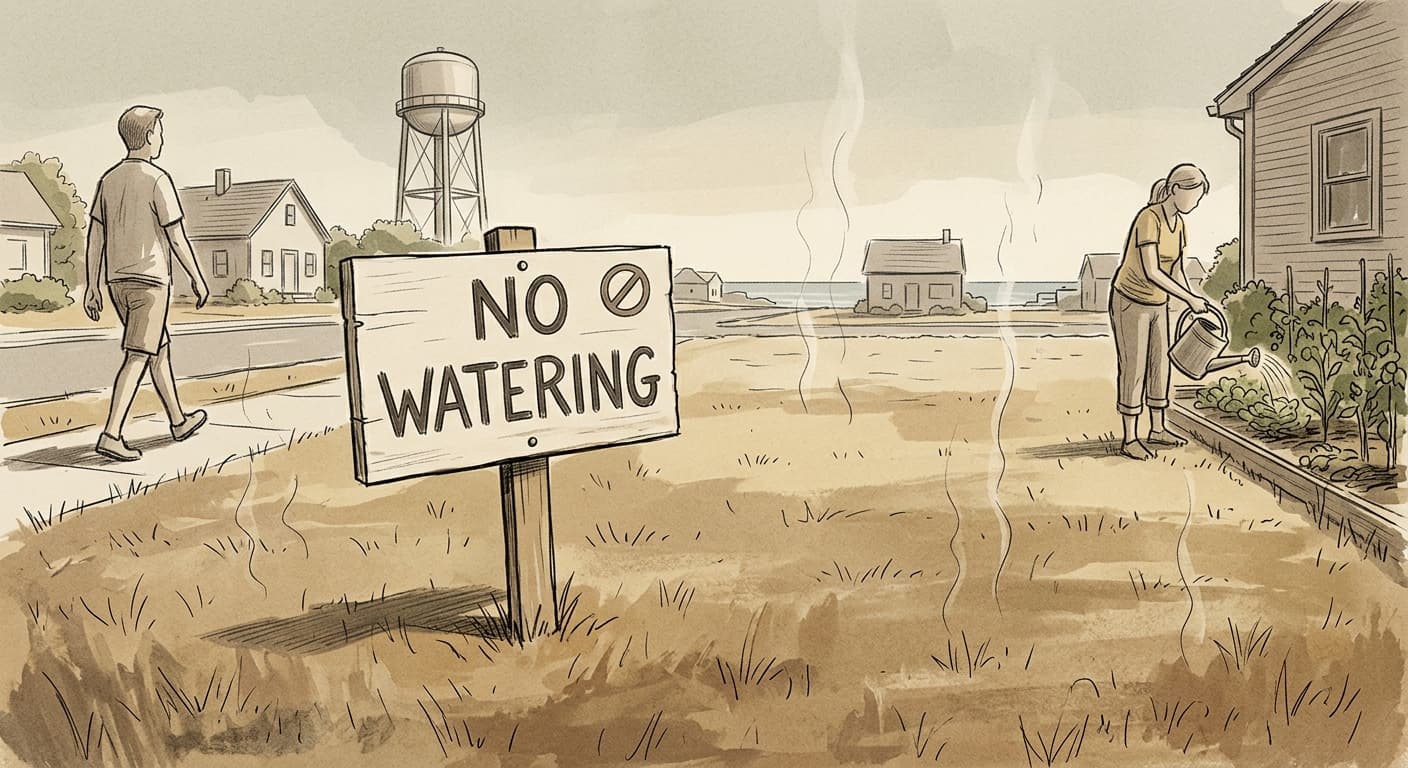
The Town of Westerly responded with an emergency ban on all outdoor residential water use, effective Friday morning, July 3, according to the Westerly Sun. The prohibition is sweeping — no watering lawns, no filling pools, no washing cars, homes or decks. It is in effect "until further notice," town officials said, with no fixed end date announced as of this writing.
The trigger, according to the Westerly Sun and WJAR/Turn to 10, was a sudden loss of water pressure in specific pockets of town. Town Manager Shawn M. Lacey told WJAR the trouble started Thursday, when residents first reported "trickles" of water rather than a total loss. By Friday, the town moved past a lighter option it had been weighing — an odd-even watering schedule — and imposed the full ban instead.
Town officials attributed the crisis to "recent drought conditions combined with increased water use due to the extreme heat," according to the town's notice reported by the Westerly Sun. What the town has not said, at least not yet, is whether the root problem is drought-driven aquifer depletion, a system capacity limit, a specific leak or some mix of the three. No technical or hydrological data specific to Westerly's system has been publicly cited to substantiate the degree of drought impact, according to available reporting.
A hospital, a beach and a border town
The stakes go beyond brown lawns. Westerly Hospital's campus relies on town water for its cooling system, and Lacey called addressing that "a priority," according to WJAR/Turn to 10. There has been no confirmation of an actual disruption to hospital operations — only that the dependency exists.
Firefighting tanker trucks from neighboring communities were brought into town to shore up supplies, the Westerly Sun reported — a sign that officials treated the pressure loss as a potential fire-suppression issue, not merely an inconvenience for gardeners.
The Westerly system also serves Pawcatuck, across the state line in Connecticut. The Town of Stonington issued its own notice to affected Westerly Water customers there on Friday, making this a rare Rhode Island water story with a Connecticut postscript.
It came a day after the state reported no fresh water at Misquamicut State Beach, due to a water line leak that knocked out drinking fountains, showers and sinks. Repairs were made overnight, and the beach stayed open — but the timing underscored how strained the region's water infrastructure had become during a stretch of the hottest days of the year, with reports of packed beaches and bumper-to-bumper traffic on Route 78.
A statewide backdrop
Westerly's ban did not happen in isolation. Two days earlier, Gov. Dan McKee issued Rhode Island's first statewide drought watch since 2002, escalating from a drought advisory issued in late May, according to the Governor's office. Meredith Brady, chair of the state's Drought Steering Committee, said groundwater reservoir and streamflow levels were "historically low" — the kind typically seen in August, not June. "Rhode Island has received 13 inches less precipitation over the past 12 months than expected in an average year, which is having a profound impact on our groundwater aquifers," Brady said.
It's important to note the state's "watch" designation is not a mandatory statewide order — conservation is "strongly encouraged" but not required, leaving binding restrictions to individual towns and utilities. That is the legal basis for Westerly's local ban. Around the same period, South Kingstown and Narragansett water customers were placed under a similar mandatory outdoor ban tied to drought and aquifer protection, according to a notice from Veolia Rhode Island — suggesting a regional South County pattern rather than an isolated Westerly problem.
What residents don't yet know
Left unanswered: how long the ban will last, what specific penalties apply for violations, and what exactly caused the pressure loss in the first place. An older Westerly civic alert references an "Emergency Ordinance imposing a penalty for the Willful Wasting of Water" from a prior ban, but it is unconfirmed whether that penalty structure applies this time.
The next official checkpoint comes in mid-July, when the state's Drought Steering Committee reconvenes to reassess conditions — a decision that could determine whether Rhode Island moves toward a more severe "drought warning" and whether Westerly's ban is lifted, extended or expanded regionally.