


There is a whole menu of ways a big company can take money out of your pocket without you noticing. A $9.99 charge that appears on month four of a "free" trial. A lease buyout price that mysteriously climbs when you show up to buy the car. A junk fee buried on page two of a bill.
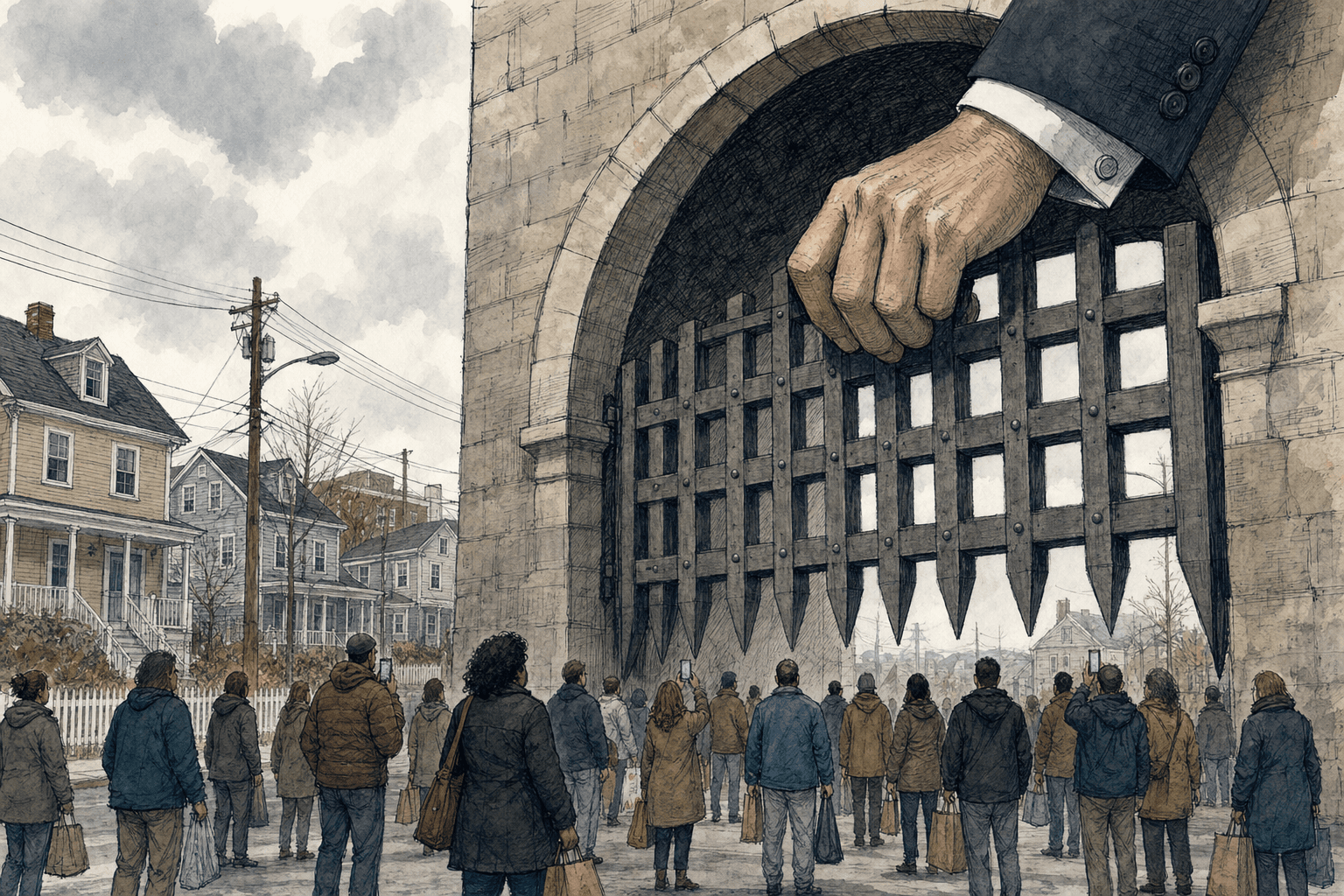
Here is the part that matters. For most of those harms, you no longer have a realistic way to fight back — not because the conduct became legal, but because the courtroom door was quietly closed. Understanding how that happened requires walking through a few Supreme Court decisions, one Rhode Island car lease, and a $111 billion media merger that just got stopped cold in California.
Start with the mechanism. The Federal Arbitration Act, passed in 1925, was written to let big businesses arbitrate contract disputes with each other instead of clogging the courts. Beginning in 1983, the Supreme Court began reading it far more expansively. In the 1995 case Allied-Bruce Terminix v. Dobson, the Court permitted companies to put arbitration clauses in routine consumer contracts. Then, in 2011, AT&T Mobility LLC v. Concepcion upheld class-action waivers inside those clauses, overturning California's policy of refusing to enforce them in take-it-or-leave-it contracts. Two years later, American Express Co. v. Italian Colors Restaurant enforced mandatory arbitration even where it left a plaintiff with no practical path to recovery at all.
Local sponsorWorld-class website design and custom software at a small business price.Company 50Translated into plain stakes: when you sign up for a cell phone, open a bank account, take a payday loan, or move a parent into a nursing home, you are almost certainly agreeing to give up your right to sue and your right to join with everyone else who got cheated the same way.
And most people have no idea. The Consumer Financial Protection Bureau found that three out of four consumers surveyed did not know whether they were subject to an arbitration clause.
Does arbitration at least work? The numbers say barely. The CFPB, in the study behind its 2017 arbitration rule, reviewed 1,060 consumer finance arbitrations filed in 2010 and 2011 and found arbitrators awarded consumers a combined total of less than $175,000 in damages and less than $190,000 in debt forbearance. Across the entire country. Across two years. More recent data from the American Arbitration Association tells a similar story: of mass arbitration cases that closed in 2024, only 1% of consumer cases and 2% of employment cases ended in awards, while 30% of consumer cases were dismissed outright.
Business groups push back, and fairly. The U.S. Chamber Institute for Legal Reform has argued consumers initiated and prevailed in 44% of consumer arbitrations that ended in awards between January 2014 and June 2020, and that arbitration is faster and cheaper than court. Both things can be true. Arbitration can be efficient for the handful of people who file — and still leave millions of small harms entirely unaddressed, because nobody sues over $10.
That is the whole point of a class action. Individually, the harm is too small to litigate. Collectively, it's worth a lawyer's time. Remove the collective piece and the math flips permanently in the company's favor.
Which brings me to a Rhode Island car dealership.
In 2019, Elsie Metcalfe leased a vehicle from Grieco Hyundai. Her lease included an option to buy the car at a set price at the end of the term. When the dealership raised that price, she sued for breach of contract and violation of the Rhode Island Deceptive Trade Practices Act — as a class. The lease contained a class-action waiver.
In October 2023, the federal District Court in Rhode Island refused to enforce it. The key detail is a technical one with large consequences: the waiver was standing alone, not embedded in an arbitration clause, so the Federal Arbitration Act was not implicated. Freed from federal preemption, the court held that because the state's Deceptive Trade Practices Act expressly gives consumers the right to bring class claims, a contract stripping that right is unenforceable as against Rhode Island public policy.
That is a real win. It is also a narrow one. Had Grieco Hyundai simply placed the same waiver inside an arbitration clause, the FAA would likely have preempted state law and the case would have vanished into private arbitration. In other words, Rhode Island law protects you right up until a company's lawyers add one more paragraph.
The federal fix has been sitting on the shelf for years. The Forced Arbitration Injustice Repeal Act — the FAIR Act — would ban forced arbitration in consumer, employment, civil rights, and antitrust disputes. The House passed it in 2019 by 225-186 and again in 2022 by 222-209. The Senate has never voted on it. Representative Hank Johnson of Georgia and Senator Richard Blumenthal of Connecticut reintroduced it in September 2025. It has not advanced.
So what actually still works? Public enforcement — and this month offered a demonstration.
On July 13, twelve state attorneys general sued to block Paramount's $111 billion acquisition of Warner Bros., arguing the deal violates federal antitrust law. The combination would join HBO Max and Paramount+, CBS and CNN, Paramount Pictures and Warner Bros. Motion Picture Group, HBO, Showtime, Discovery+ and 15 CBS-owned local stations. The states allege it would raise cable and movie ticket prices, shrink news and entertainment choices, and depress pay for industry workers. Those are allegations, not findings.
They filed anyway — after the Justice Department's Antitrust Division announced in June that it had reviewed the transaction and found it "not likely" to harm competition or consumers.
On July 21, Judge Araceli Martínez-Olguín of the Northern District of California granted a 14-day temporary restraining order, finding serious questions going to the merits. Three days later, Paramount agreed by joint stipulation not to close until five days after trial or June 1, 2027, whichever comes first. Paramount disputes the states' case, calling the suit "a fundamentally flawed application of the antitrust laws" that is "wrong on both the facts and the law," and warning that delay "will only harm entertainment workers."
Rhode Island is not among the twelve. The coalition — led by California Attorney General Rob Bonta — includes Arizona, Colorado, Connecticut, Massachusetts, Minnesota, Nevada, New Jersey, New Mexico, New York, Oregon and Washington. Connecticut and Massachusetts, our immediate neighbors, are in. We are not.
Which returns us to the menu. When private lawsuits disappear, the only enforcers left are attorneys general and federal agencies — and whether they show up is a choice, made by named people, case by case. Twelve of them showed up in California this month. The trial there will decide whether a $111 billion merger closes. Whatever happens to your $9.99 charge is up to somebody else.