


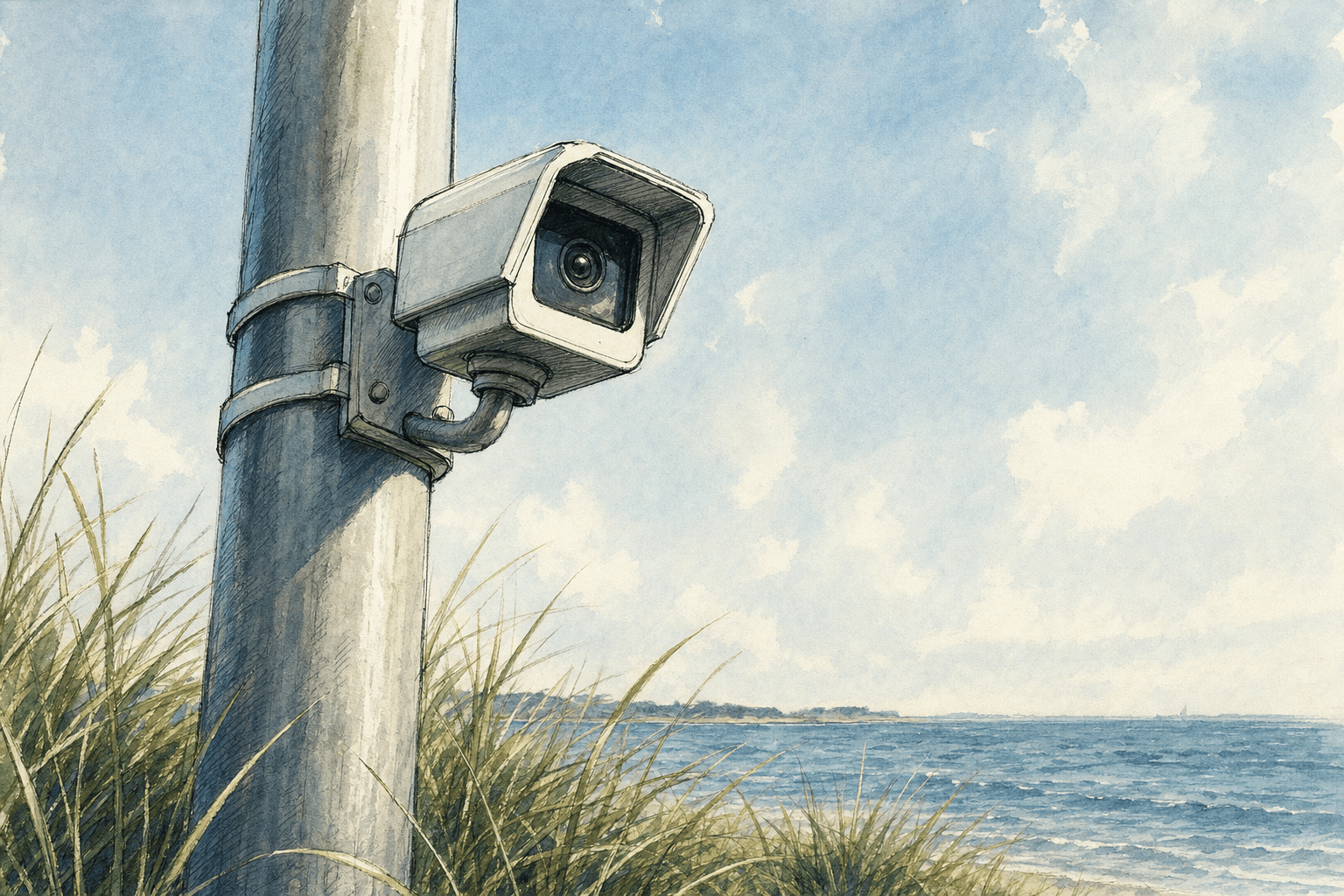
A public beach camera installed on Charlestown Town Beach was stolen on Thursday, the town reported in an official statement that went well beyond the usual language of a municipal theft notice.
The camera was a live-feed unit installed for the University of Rhode Island's Ocean-CREST project, short for Oceanfront Observatory for Coastal Resilience, Engineering, Science & Technology. It fed a public view of beach and water conditions and supported coastal research and education. It replaced an earlier camera that was destroyed when its mounting pole snapped during a severe storm, according to the town.
The town's notice, headlined "Newly Installed Public Beach Camera Stolen in Disgraceful Act Against the Community," said officials were "outraged." It described the theft as not a harmless prank but "a selfish, destructive, and criminal act that deprived the public of a resource funded, installed, and maintained for everyone's benefit." The statement added that whoever took the camera "did not steal from an anonymous government agency," but from "Charlestown residents, beachgoers, students, educators, coastal researchers, and every member of the public."
Local sponsorAffordable photography lessons in Newport, Jamestown, or your town.E.L. Photo RIMuch of the statement is devoted not to the theft itself but to a rumor. The town said claims had circulated that the equipment was a Flock camera — an automated license plate reader — and called those claims "completely false" and evidence of "a basic failure to understand, or even verify, what had actually been installed." A "minimal amount of effort," the statement said, would have confirmed the camera's purpose was public viewing and coastal education, "not vehicle tracking or law enforcement surveillance."
The town did not say who spread those claims, how widely they circulated, or whether they had anything to do with the theft. The motive remains unknown, and the town has not said whether police have identified a suspect.
Two different kinds of camera
The distinction the town is drawing matters, because Rhode Island has spent the summer arguing about surveillance cameras.
Flock Safety devices photograph passing vehicles and store the images in a searchable database, typically for about a month. They read license plates. The Charlestown camera was a fixed-view CR63-E with a built-in LTE modem, an internal battery, 4K resolution and the option of solar or hard-wired power, according to reporting by The Westerly Sun on the project's approval. Because the camera cannot pan or tilt, town and university officials told the council that beachgoers would not face privacy concerns.
The installation was approved in public. Rhode Island Sea Grant coastal resilience specialist Casey Tremper and URI associate professor of ocean engineering Reza Hashemi presented the re-installation request to the Charlestown Town Council in November, and the council voted to allow it, with activities coordinated through the town administrator. URI covered the equipment; the town handled installation. The feed was made publicly accessible through the Web Camera Coastal Observation System, and the town maintains a live beach camera page.
A hostile season for cameras
The theft landed at the peak of a statewide backlash against license plate readers. The South Kingstown Town Council voted unanimously on July 27 to cancel its Flock Safety contract and remove the cameras. Narragansett's council did the same on Aug. 3. The ACLU of Rhode Island, which has campaigned against the technology, counts at least 295 Flock cameras in the state and notes the exact figure is unknown because some police departments have been difficult to get information from.
Those objections are about warrantless records of drivers' movements — a debate with no bearing on a fixed camera pointed at the surf. But the sequence is close enough in time that the town's statement reads as an attempt to break the association, sharply.
What the notice does not address is cost. The town has not disclosed what the stolen camera was worth, who pays to replace it, or what security measures might protect a third unit. It also has not said whether a replacement is planned.