


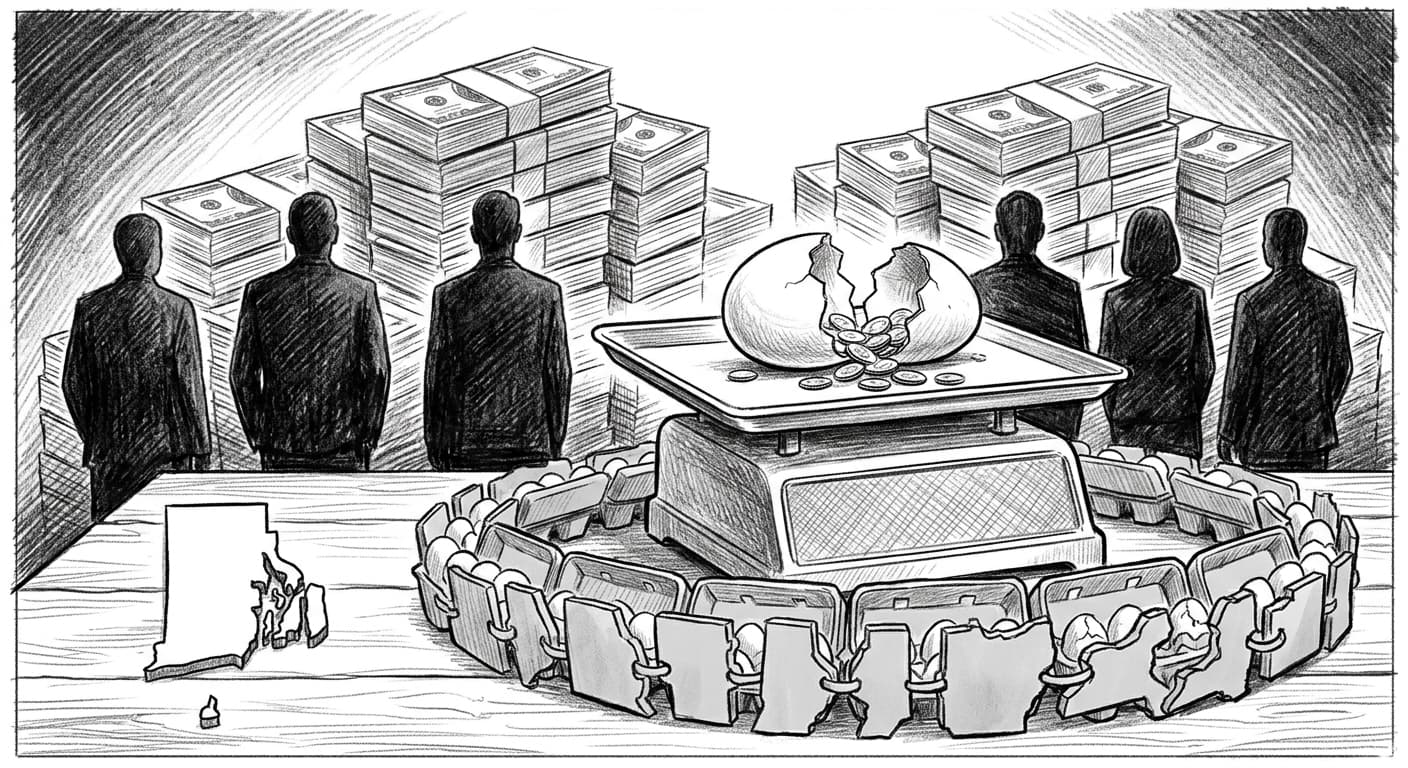
There's a lot happening in the world of grocery prices right now — tariffs, consolidation fights, the slow unwinding of pandemic-era inflation. But let's talk about eggs. Specifically, on a settlement announced June 30 that shows in miniature how antitrust enforcement can declare victory while leaving consumers — especially Rhode Island consumers — with almost nothing.
Here's the deal. The U.S. Department of Justice's Antitrust Division and 17 state attorneys general announced a proposed civil settlement with three of the nation's largest egg producers — Cal-Maine Foods, Hickman's Egg Ranch, and Versova — resolving allegations that the companies coordinated to manipulate egg prices between June 2022 and March 2025. The companies will pay a combined $3.3 million, donate roughly 53 million eggs to food banks, and admit no wrongdoing.
Now the numbers. Cal-Maine, the only publicly traded company of the three, reported a profit of $1.22 billion for fiscal 2025 alone, according to its SEC filings. Its share of the settlement is $1.5 million. That's roughly 0.12 percent of one year's profit — for allegations spanning nearly three years. Matt Stoller, who writes the antitrust newsletter BIG, calculates that Cal-Maine's fine plus the cost of its donated eggs totals about $3 million against what he estimates was more than $3 billion in profits across the alleged conspiracy window — a thousand-fold return. That $3 billion figure is Stoller's estimate, not a government finding, and it can't be fully verified because Versova and Hickman's are privately held. But the Cal-Maine comparison stands on its own public filings. Angela Huffman, president of the advocacy group Farm Action, called the settlement a mere "business expense" for multi-billion-dollar corporations.
The alleged mechanism matters here. According to the DOJ complaint, the companies coordinated to artificially inflate the daily price quotations of Urner Barry, a market reporting company whose benchmarks affect what grocery stores and restaurants pay for eggs nationwide. In one example from December 2022 cited by prosecutors, Hickman's CEO emailed the others to submit "strong bids, early and often" to push prices up. Prosecutors also noted that egg prices fell from record highs after the companies learned of the investigation.
The companies dispute all of it. Cal-Maine called the allegations "baseless" and blamed price surges on avian influenza outbreaks, COVID-19, weather, and inflation. CEO Sherman Miller said the referenced communications came from "a single former employee" and didn't affect prices. Versova said "egg farmers in the United States don't set the wholesale price of eggs." DOJ, for its part, defends the deal: Deputy Assistant Attorney General Nicole Sarrine said the settlements "will keep egg prices competitive and keep money in the hands of consumers across the country."
Across the country — with exceptions. Rhode Island is not one of the 17 states party to the settlement. Connecticut is in. Vermont is in. Rhode Island and Massachusetts are not. That means no settlement dollars and no donated eggs for Rhode Island food banks, even though Rhode Islanders paid the same inflated national prices as everyone else. No evidence explains why Rhode Island wasn't a party, and Attorney General Peter Neronha's office has issued no public statement on the settlement.
And Rhode Islanders paid. In January 2023, Sen. Jack Reed wrote the FTC noting Rhode Island customers paid an average of $5.10 for a dozen eggs in December 2022, according to Instacart, while Cal-Maine reported record quarterly profits of $323 million. Reed toured Baffoni's Poultry Farm in Johnston — about 7,000 laying hens on 80 acres — highlighting that local family farmers kept prices relatively stable while national producers' prices soared. By February 2025, his office noted Rhode Islanders were paying anywhere from $4.55 to $6.99 a dozen at local chains, with some restaurants adding a 50-cent-per-egg surcharge. Reed's letters concerned price gouging generally, not this specific case — but the paper trail shows Rhode Island's federal delegation was pressing the issue years before DOJ's probe.
One more mechanic worth knowing: because the companies admitted no wrongdoing, consumers and restaurants can't use any admissions in follow-on suits, and the settlement releases the companies from claims. A separate private class-action lawsuit, filed before the DOJ settlement, was already underway.
The deal isn't final. It requires federal court approval under the Tunney Act, with a 60-day public comment period before a judge in the Northern District of Iowa can enter judgment. Egg prices, meanwhile, have collapsed — a carton of large Grade A eggs now averages $2.19, down from $6.23 in March 2025, per the Federal Reserve Bank of St. Louis.
So where does that leave Rhode Island? Paying the inflated prices, absent from the settlement, and watching from outside. The fine was pocket change. We're not even getting the pocket change.