


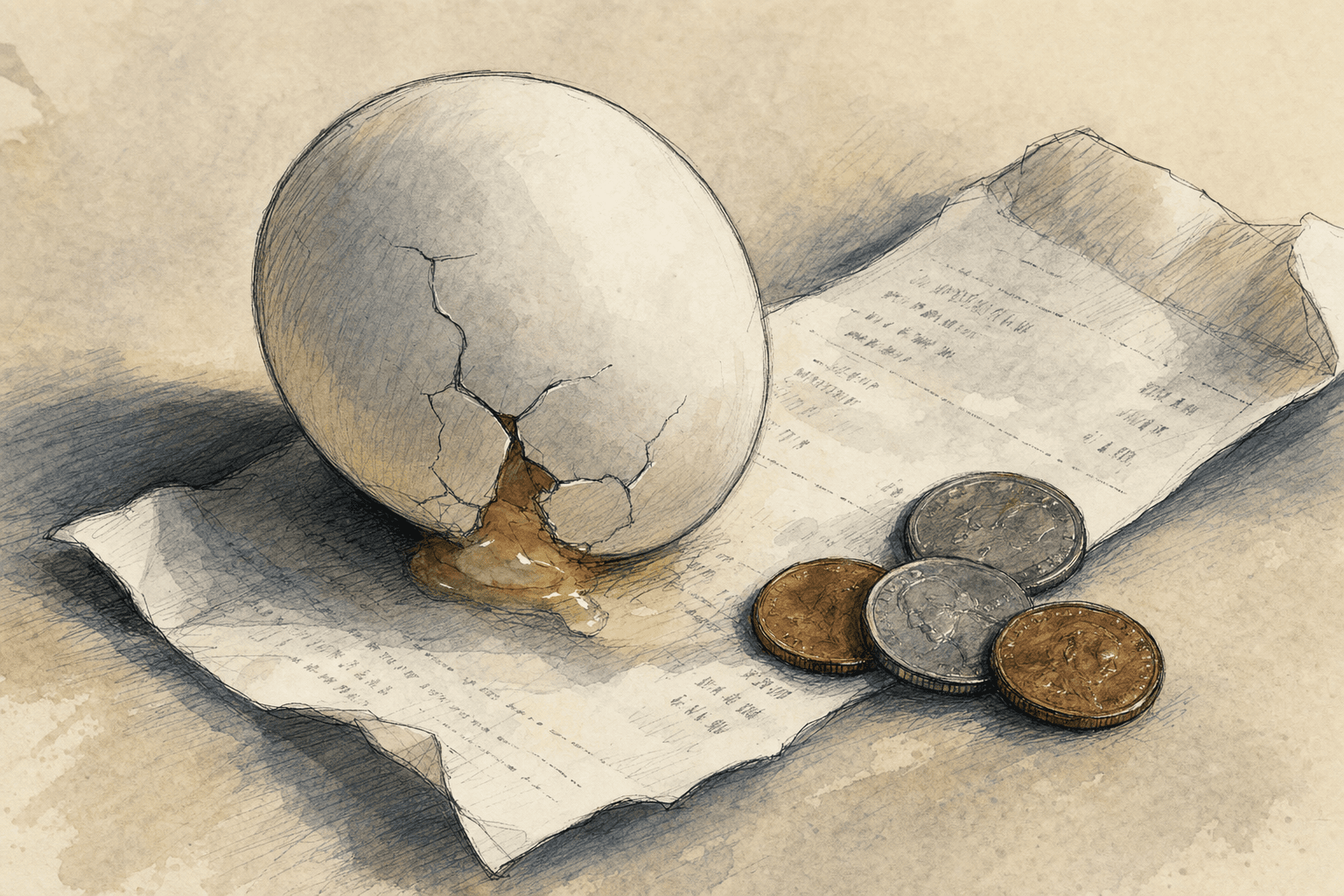
What happened in a federal courtroom in Iowa on June 29 tells you almost everything about how antitrust enforcement is supposed to protect you at the checkout line, and how it can fall short.
Here's the shape of it. The U.S. Department of Justice and a bipartisan coalition of 17 state attorneys general filed a civil antitrust lawsuit against three of the country's largest egg producers — Cal-Maine Foods, Versova, and Hickman's Egg Ranch — and simultaneously announced proposed settlements. The complaint alleges the companies coordinated their bidding between June 2022 and March 2025 to artificially inflate the benchmark price of wholesale eggs. The producers admitted no wrongdoing. And the total cash penalty across all three firms? $3.3 million.
That number is the whole story.
Cal-Maine, the nation's largest egg distributor, agreed to pay $1.5 million of it. In its 2025 fiscal year, Cal-Maine reported $1.22 billion in profit. Do the arithmetic: the penalty is roughly one-tenth of one percent of a single year's take. Watchdog groups noticed. On July 7, the American Economic Liberties Project — an anti-monopoly nonprofit — demanded a congressional hearing, calling the deal a "toothless" "slap on the wrist" that fails to deter what it characterized as a "cartel." Farm Action made a parallel argument, contrasting the fine directly against Cal-Maine's billion-dollar profit.
Rhode Island's senior senator got there first. On July 1, Jack Reed issued a statement calling the settlement "soft boiled." He said he was glad the producers were "named and shamed," but that the deal let bad actors off too easily and demanded DOJ lawyers "show their math" on how they arrived at those light penalties.
Reed has been chasing this issue for years. In January 2023, he was among the first in Congress to formally ask the Federal Trade Commission to investigate egg price-gouging, back when Rhode Islanders were paying an average of $5.10 a dozen. In May 2025 he introduced S. 1904, the Ending Taxpayer Support for Big Egg Producers Act, which would deny federal bird-flu indemnity payments to producers with over $100 million in revenue unless they certify they won't pay dividends or buy back stock for two years. The bill was referred to the Senate Agriculture Committee and has drawn heavy opposition from farm lobbies.
Now, how does anyone rig the price of eggs? Follow the mechanism. Most commercial egg contracts — roughly 89% — are tied to daily benchmark quotes published by Urner Barry. Those quotes lean heavily on spot-bidding activity at the Egg Clearinghouse Inc. platform, where only about 11% of eggs actually change hands. According to the lawsuit, the producers flooded that thin market with high-volume bids — many structured never to result in real trades — to manufacture a false impression of desperate demand. The New York attorney general's office, which co-led the state coalition, pointed to a December 2022 email in which Hickman's CEO urged executives at the other firms to submit "strong bids, early and often." Prosecutors also noted that benchmark prices dropped sharply the moment the companies received document-preservation notices in March 2025.
None of this happened in a vacuum. Highly pathogenic avian influenza was real, and it forced the slaughter of tens of millions of laying hens. The companies insist the flu, the pandemic, and severe weather — not any coordination — drove prices up. Cal-Maine CEO Sherman Miller called the lawsuit "baseless" and said the firm settled only to avoid costly litigation. A Versova spokesperson said the company was "pleased" to put the matter behind it. The government's argument is narrower and sharper: while the flu tightened supply, the alleged bidding scheme pumped prices far beyond what that shortage justified — the national flock dipped 5% to 6%, while retail egg prices climbed more than 138%.
The DOJ defends its deal. Deputy Assistant Attorney General Nicole Sarrine said the agreements "will keep egg prices competitive and keep money in the hands of consumers." The settlement includes a five-year compliance monitoring term and forces the donation of 53 million eggs to food banks.
Rhode Island won't see those eggs. Because the state's attorney general wasn't among the 17 parties to the suit, no direct allocation was made here — even as local pantries strain and families keep absorbing high grocery costs.
So return to that $3.3 million. Reed wants the math. The watchdogs want CEOs under oath. The open question is whether a rounding-error fine deters the next scheme, or simply prices it in as a cost of doing business. No hearing has been scheduled yet.